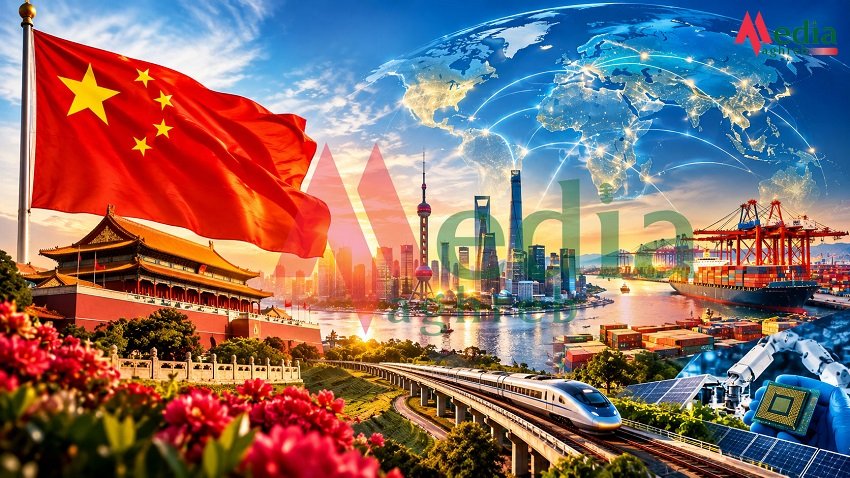
China at 77: From the Legacy of Revolution to the Challenges of Global Power
An extended narrative feature marking the 77th anniversary of the founding of the People’s Republic of China. The 77th anniversary of the People’s Republic of China should not be viewed merely as an occasion to revisit the country’s political history. It also offers an opportunity to understand the trajectory that has led China to become one of the most influential powers in international economic and political affairs. On October 1, 1949, when Mao Zedong proclaimed the establishment of the People’s Republic in Beijing’s Tiananmen Square, China entered a new historical phase focused on rebuilding the state, consolidating its institutions and establishing a new political system amid the tensions of the Cold War. The proclamation followed years of civil war between the Chinese Communist Party and the Kuomintang, ultimately resulting in Communist control of mainland China, while the government of the Republic of China relocated to Taiwan.
During the republic’s first decades, the Chinese leadership focused on building state institutions, developing a national industrial base and restructuring the economy according to a socialist model. This period witnessed wide-ranging economic and social policies, including land reform, industrialization and central planning. It also saw profound political and humanitarian crises, particularly during the Great Leap Forward and the Cultural Revolution. Understanding this period remains essential to interpreting China’s subsequent transformation, as the country’s economic rise did not emerge in a vacuum. Rather, it was the product of accumulated institutional foundations and diverse political and economic experiences.
Reform and Opening-Up: The Turning Point That Changed China’s Economic Trajectory
December 1978 marked a decisive turning point in the history of the People’s Republic of China, when the Chinese leadership began redirecting national priorities toward economic development and launched the reform and opening-up process most closely associated with Deng Xiaoping. China gradually introduced market mechanisms, expanded economic incentives, established special economic zones and encouraged foreign investment. These measures enabled the country to move from a highly centralized economic system toward a model combining public ownership, market instruments and strategic planning. The process reshaped China’s relationship with the global economy and laid the foundations for its emergence as a major center of manufacturing and international trade.
Economic opening was not merely an adjustment to the mechanisms governing production. It represented a transformation in China’s position within the international system. The expansion of manufacturing, trade and infrastructure investment increased the country’s capacity to integrate into global value chains, while investment in education, science and technology helped establish a broad industrial and knowledge base. Over time, China moved beyond its initial emphasis on low-cost manufacturing to develop more sophisticated sectors, including electronics, telecommunications, industrial equipment, renewable energy and electric vehicles. The full impact of this transformation, however, must be assessed through multiple indicators, including productivity, income, social inequality, environmental performance and the country’s capacity for innovation.
China Under Xi Jinping: Development and Security at the Heart of the Strategic Vision
Since Xi Jinping assumed leadership of the Chinese Communist Party in 2012 and became president in 2013, the official discourse has increasingly emphasized the concept of the “great rejuvenation of the Chinese nation.” Economic development has become closely linked to national security, technological independence and the ability to withstand external pressures. This approach has coincided with a stronger focus on party discipline and anti-corruption efforts, as well as an expanded state role in strategic sectors, alongside continued emphasis on innovation and high-quality growth. Within this framework, economic competition in Beijing is no longer understood solely as a commercial contest; it is also closely connected to supply-chain security, digital capabilities and advanced industries.
The 77th anniversary coincides with China’s transition into a new phase of economic planning, amid the discussion and implementation of priorities under the 15th Five-Year Plan for 2026–2030. The announced priorities focus on strengthening innovation, developing advanced productive forces, supporting cutting-edge technologies, expanding domestic consumption and improving the quality of economic growth. This direction reflects an official recognition that maintaining China’s competitiveness requires reducing reliance on certain traditional growth drivers and developing higher-value industries at a time when the country faces mounting pressures linked to global demand and technological competition.
China’s Economy Between Manufacturing Strength and Domestic Transformation Pressures
China retains a central position in the global economy thanks to the scale of its industrial base, the breadth of its trade networks and its ability to manufacture a wide range of products, from electronic equipment to automobiles, machinery and chemical goods. Maintaining this position, however, presents challenges linked to changing patterns of demand, a slowdown in parts of the property sector, accumulated financial pressures on some local governments and the need to strengthen domestic consumption. As a result, China’s economic policies increasingly emphasize a shift away from heavy reliance on investment and exports toward a model that gives greater weight to domestic demand, services and innovation.
These challenges are closely intertwined with intensifying competition between China and the United States in technology, trade and industry. Access to advanced semiconductors, sensitive industrial equipment and strategic materials has become part of broader geopolitical calculations. Beijing is seeking to strengthen domestic capabilities in sectors it considers critical to its economic security. At the same time, trade relations between China and major global economies remain deeply interconnected, making a comprehensive economic decoupling costly for all sides. This interdependence helps explain why negotiations and competition continue simultaneously.
Renewable energy, electric vehicles, batteries, telecommunications and artificial intelligence are among the leading fields in which China is seeking to strengthen its capabilities. These sectors offer opportunities to develop higher-value exports, but they have also intensified international disputes over industrial subsidies, trade rules and market access. China’s industrial future will therefore depend on its ability to balance production expansion with greater efficiency, compliance with environmental and technical standards, and stronger domestic and international demand.
Taiwan and the South China Sea: Security Policy and Its Impact on the Global Economy
The Taiwan issue remains one of the most sensitive matters in Chinese foreign policy. Beijing regards the island as part of its territory and maintains its stated objective of achieving reunification. Taiwan, meanwhile, administers its own affairs independently and maintains close economic and security relations with a number of international partners, while countries differ in their positions regarding the island’s political and legal status. The significance of the issue extends well beyond East Asia, given Taiwan’s role in semiconductor manufacturing and the potential impact of any major escalation on global trade and supply chains.
In September 2026, Taiwan once again featured prominently in discussions surrounding China-U.S. relations ahead of a planned meeting between U.S. President Donald Trump and Chinese President Xi Jinping. International coverage examined concerns that trade negotiations could influence the parties’ calculations regarding the island, given the issue’s sensitivity for China, the United States, Japan and Taiwan. These developments cannot be separated from broader economic risks, as a significant escalation could disrupt trade, investment, maritime transport and technology markets.
The Belt and Road Initiative: An Instrument of Economic Expansion and Trade-Corridor Development
China launched the Belt and Road Initiative in 2013 to strengthen infrastructure, trade and investment links between China and its partners across various regions of the world. The initiative has included projects involving ports, railways, roads, energy and telecommunications, contributing to the expansion of Chinese companies and financial institutions in a number of emerging markets. Beijing presents the initiative as a framework for economic cooperation and shared development, while international debate has focused on financing conditions, debt sustainability, environmental consequences and the geopolitical implications of certain projects.
The initiative’s importance to Africa and the Maghreb is closely linked to the development of trade corridors connecting ports with industrial centers and inland markets. Africa requires substantial investment in transport, energy and telecommunications, and partnerships with China can provide financing, expertise and equipment across a range of sectors. However, achieving long-term development benefits requires careful economic feasibility assessments, transparent contracts, stronger participation by local businesses and assurances that new infrastructure supports production and trade rather than merely facilitating the transit of goods.
In North Africa, Egypt stands out as a strategically important partner for China, given its geographic position, the Suez Canal, the size of its domestic market and its commercial links with Africa and the Middle East. During the Chinese president’s visit to Cairo in September 2026, the two sides discussed expanding economic and investment cooperation as they marked seven decades of diplomatic relations. Announced developments point to continued Chinese interest in infrastructure, manufacturing and energy in Egypt, reflecting the importance of trade corridors and industrial zones in China’s international economic strategy.
China and Africa: An Economic Partnership Extending Beyond Trade to Technology and Energy
China-Africa relations have evolved over decades from diplomatic and commercial cooperation into partnerships encompassing infrastructure, mining, energy, telecommunications, education and manufacturing. The Forum on China-Africa Cooperation has emerged as one of the principal platforms for coordinating economic and political priorities between Beijing and African countries. China is showing growing interest in African markets not only as sources of raw materials but also as destinations for trade and investment, amid population growth and rising demand for energy, goods and services across the continent.
In 2026, China-Africa relations carry an additional symbolic and political dimension as countries commemorate seven decades of diplomatic ties between China and the African continent and designate the year as an opportunity to strengthen people-to-people and cultural exchanges. Cooperation in vocational training, agricultural technology, renewable energy and digital services could support the development of local capabilities in Africa, provided that projects are aligned with African economic needs and partnerships move beyond a model based on exporting primary commodities and importing manufactured goods.
China-Africa economic cooperation is becoming increasingly significant as African countries seek to diversify their international partners and capitalize on competition among major economic powers to attract investment and improve infrastructure. China, in turn, is looking for new markets, strategic resources and more diversified production and trade networks. This intersection of interests makes economic cooperation an important component of bilateral relations, but it does not eliminate the need to address issues involving debt, transparency, technology transfer and the environmental and social impact of major projects.
China and the Maghreb: Economic Interests Amid Geopolitical Transformations
The significance of China’s relations with the Maghreb extends beyond direct trade to encompass energy, infrastructure, manufacturing, maritime transport and food security. The region lies at the intersection of trade routes connecting the Mediterranean with the Atlantic Ocean and sub-Saharan Africa. It also possesses natural resources, consumer markets and a strategic location close to Europe. From an economic perspective, these characteristics create opportunities for Chinese partnerships in port development, industrial zones and renewable energy, while expanding the presence of Asian companies in African markets.
The nature of China’s economic relations with Maghreb countries varies according to the specific characteristics and priorities of each economy. Algeria, with its energy resources and strategic position in North Africa, offers potential for cooperation in energy, manufacturing and infrastructure. Morocco presents opportunities in the automotive industry, renewable energy, logistics and export-oriented manufacturing. Tunisia, Libya and Mauritania likewise offer varying prospects in industry, services, energy and mining, although the ability to capitalize on these opportunities depends on the political, financial and regulatory conditions prevailing in each country.
The capacity of Maghreb countries to convert external partnerships into local value added remains a central issue. Importing equipment or implementing infrastructure projects does not, in itself, guarantee technology transfer or the localization of industry. Achieving these objectives requires investment partnerships to be linked to vocational training, the development of local suppliers, research and innovation, and improvements in the business environment. In this context, cooperation with China can represent one of the available avenues for the region’s economies as part of a broader strategy to diversify partners and benefit from ties with Europe, Africa and Asia.
China and the International System: Toward a More Multipolar Distribution of Power
The 77th anniversary comes amid growing international debate over the future of the global order, the limits of American influence, the rise of major Asian economic powers and the expanding role of groupings bringing together emerging economies. China is seeking to expand its presence in multilateral institutions and platforms, including BRICS, while advancing initiatives related to economic cooperation, financing, technology and global governance. In its diplomatic discourse, Beijing emphasizes multilateralism and respect for national sovereignty. Analysts, meanwhile, view the expansion of Chinese partnerships as a means of strengthening the country’s influence over the formulation of international rules.
At the BRICS summit held in New Delhi in September 2026, China put forward proposals to strengthen cooperation in artificial intelligence, trade, services and finance, including the establishment of an open-source artificial intelligence platform and the expansion of economic partnerships among member states. These initiatives reflect Beijing’s efforts to make technological and economic cooperation part of the agenda of emerging international groupings, at a time when countries in the Global South are seeking a greater role in international financial and trade institutions. Turning these proposals into sustainable arrangements, however, will require practical agreements on financing, standards and governance.
Artificial Intelligence and Technology: A New Arena for International Competition
Advanced technology has become one of the most prominent arenas of competition between China and the world’s major industrial powers. Beijing is placing increasing emphasis on artificial intelligence, semiconductors, robotics, clean energy and telecommunications, viewing these industries as essential to productivity, economic security and industrial self-reliance. This approach is reflected in policies promoting the development of “new quality productive forces,” increased investment in scientific research and the integration of technology into manufacturing, services and public administration.
Technological progress, however, cannot be measured solely by the number of patents or the volume of investment. It must also be assessed by an economy’s ability to turn knowledge into competitive products and services and address issues involving data protection, network security and workforce training. Restrictions on the transfer of certain technologies and equipment between China and Western countries may also affect the pace of development in some industries, prompting companies to reconsider supply chains and sources of critical inputs.
These developments create opportunities for cooperation between China and Africa, particularly in digitalization, smart agriculture, electronic payments, energy and urban management. Technology transfer, however, requires institutional partnerships, training programs and local maintenance and development capabilities. Otherwise, the benefits may remain limited to the purchase of systems and equipment. The challenge for African economies is therefore not simply to import technology, but to build ecosystems capable of producing, adapting and deploying it to meet development needs.
The 77th Anniversary: Between the Achievements of the Past and the Questions of the Future
On its 77th anniversary, the People’s Republic of China looks back on a long historical journey during which it evolved from a country emerging from wars and internal conflict into a major industrial, commercial and technological power with a global presence. The transformations launched under reform and opening-up helped reshape the Chinese economy, while extensive investments in infrastructure, education, science and manufacturing strengthened the country’s position in the international economy. At the same time, China’s experience remains the subject of debate over the balance between development, governance, social rights and environmental protection, with interpretations varying according to political and intellectual perspectives.
China faces a complex set of challenges in the next phase of its development, including strengthening domestic demand, addressing imbalances in parts of the economy, promoting innovation, managing trade relations with major powers and maintaining the stability of supply chains. It will also need to balance development objectives with economic security, and international market openness with the development of domestic capabilities in strategic industries. These challenges are particularly significant as the international environment changes and the economy becomes increasingly intertwined with technological and geopolitical competition.
For Africa and the Maghreb, China’s rise presents both opportunities and challenges. Chinese partnerships can contribute to the development of infrastructure, manufacturing, energy and services, but they require African and Maghreb governments to adopt clear negotiating strategies, strengthen institutions responsible for contract management and develop policies aimed at localizing production and increasing value added. The ability of these countries to derive maximum benefit from their international relationships will remain closely tied to partner diversification, improved governance, investment in education and skills, and stronger economic integration across the continent.
Conclusion: China After 77 Years of Statehood—An Influential Power in a Changing World
The 77th anniversary of the founding of the People’s Republic of China comes at a moment when historical achievements intersect with the challenges of the future. Over several decades, China has built a broad-based economy, strengthened its industrial and technological capabilities and expanded its diplomatic and commercial presence. Decisions made in Beijing now have implications far beyond the country’s borders, affecting global trade flows, energy markets, technology and international relations.
Maintaining this influence, however, is not a foregone conclusion. It will depend on China’s ability to manage domestic transformations, preserve the dynamism of its economy, navigate competition with major powers and develop its relationships with countries across the Global South. For African and Maghreb countries, partnerships with China represent an important option, but they require approaches that place local development, knowledge transfer and financial sustainability at the center of economic policy.
Between the legacy of its 77-year history and its ambitions for the future, China appears to be entering a new phase in the redefinition of its global position. The results of this phase will not be measured by economic power alone, but also by the country’s ability to manage international balances, turn technological progress into sustainable development and build mutually beneficial partnerships across Asia, Africa, the Maghreb and the wider world.
Share this content:









إرسال التعليق