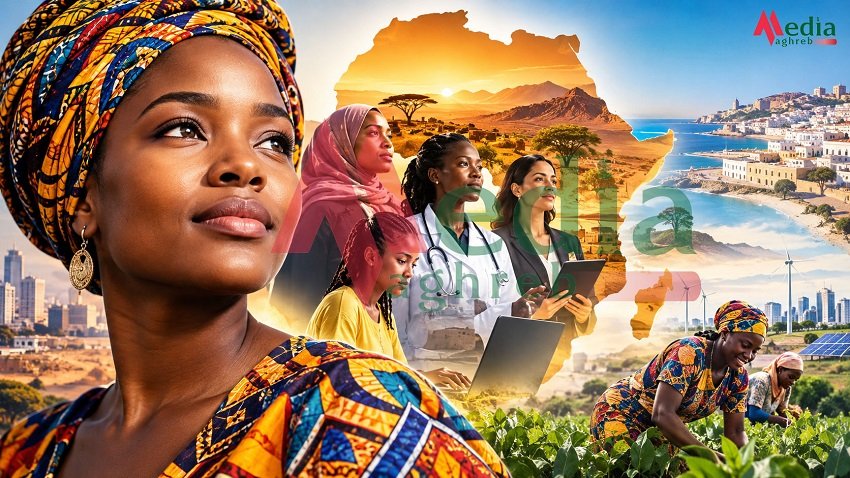
Women’s Empowerment in Africa: From Legislation to Economic and Political Influence in the Sahel and Maghreb
Women’s empowerment in Africa is no longer viewed as a social issue separate from broader development agendas. It has increasingly become one of the key indicators of a country’s ability to build more inclusive economies and more stable societies. In recent years, the debate over women’s empowerment in Africa has shifted from viewing women’s rights primarily as a social objective to recognizing women as a direct force for economic growth, decision-making, food security, innovation, peace and stability.
Yet the picture of women’s empowerment across Africa remains highly uneven. While several African countries have made significant progress in women’s political participation, others continue to face major gaps in education, employment, access to finance, asset ownership and decision-making. This contrast becomes particularly visible when comparing experiences in Southern, Eastern and Western Africa with the realities facing women in the Sahel region and the Maghreb.
Women’s Empowerment in Africa: Statistics Reveal Both Progress and Persistent Gaps
The latest international data indicate that sub-Saharan Africa has made notable progress over the past decade in increasing women’s representation in management and economic leadership. By 2025, the region recorded the world’s highest share of women in managerial positions, at 44.6%. However, this progress does not mean that gender gaps have been eliminated. Women’s political and economic participation continues to vary considerably from one country to another, while access to employment, finance and productive assets remains strongly influenced by geography, education, economic structure and social conditions.
Women’s participation in the labor force also illustrates one of the most significant contradictions surrounding women’s empowerment in Africa. While female labor-force participation exceeds relatively high levels in a number of sub-Saharan African economies, it remains considerably lower in parts of North Africa and the Sahel. In some countries, high female participation is also closely linked to agriculture and informal employment rather than stable, formal or higher-income jobs.
This distinction is particularly important when assessing women’s economic empowerment in Africa. A significant share of women’s economic activity takes place outside the formal economy, including agriculture, small-scale trade, family businesses and microenterprises. As a result, conventional labor-market statistics do not always fully capture the scale of women’s contribution to national economies.
This is why economic empowerment programs across Africa are increasingly focusing on access to finance, digital skills, markets and productive assets, alongside efforts to address the legal and social constraints that prevent women from moving from vulnerable economic activity into sustainable businesses.
The Sahel Region: Women’s Empowerment Amid Poverty, Climate Pressure and Instability
In the Sahel region, women’s empowerment carries additional layers of complexity. Poverty, limited employment opportunities, climate change, displacement, armed conflicts and growing pressure on natural resources all affect women’s economic and social prospects.
Against this backdrop, women’s empowerment in the Sahel region is no longer limited to increasing women’s representation in political institutions. It is increasingly connected to their ability to secure independent sources of income, access capital, obtain social services and participate in decision-making within their families and communities.
Regional experience indicates that programs combining financial support with training and life skills can generate simultaneous economic and social benefits. In this context, women are increasingly being treated not simply as recipients of assistance but as economic actors capable of generating income, building assets and strengthening the resilience of households and communities.
One of the most significant regional experiences is the Sahel Adaptive Social Protection Program’s productive-inclusion approach, which has been implemented in countries including Burkina Faso, Chad, Mali, Mauritania, Niger and Senegal.
Results from programs supported across the region indicate that women account for the overwhelming majority of beneficiaries in several interventions. These programs have been associated with increases in income, decision-making capacity and asset accumulation, as well as improvements in confidence and intra-household and community relationships.
The significance of this model lies in its shift from the concept of temporary assistance to investment in women’s productive capacities, particularly in rural communities where agriculture and local trade remain major sources of livelihoods.
In June 2025, regional assessments indicated that economic-inclusion programs in the Sahel region were directly targeting women, with women accounting for more than 90% of beneficiaries in some programs. The initiatives have also focused on specific barriers facing women, including the time burden associated with unpaid care work, limited access to assets and capital, and social restrictions within households and communities.
This reinforces the importance of moving from an assistance-based approach to an investment-based model that enables women to become sustainable economic participants.
SWEDD+: A Major Regional Initiative for Women and Girls
The Sahel Women’s Empowerment and Demographics (SWEDD) initiative has become one of the most prominent regional programs associated with women’s and girls’ empowerment in the Sahel and West Africa.
Launched in 2015 with support from the World Bank and technical assistance from the United Nations Population Fund and the West African Health Organization, the initiative entered a broader new phase beginning in 2024.
SWEDD+ focuses on empowering women and girls, changing harmful social norms, improving reproductive-health services and strengthening public policies. Its current phase includes countries such as Burkina Faso, Chad, The Gambia, Mali, Mauritania, Senegal and Togo.
The initiative represents one of the most important regional frameworks linking women’s empowerment with human capital development, social transformation and economic opportunity in the Sahel region.
Mauritania: A Key Link Between the Sahel and the Maghreb
Mauritania occupies a distinctive position in the geography of women’s empowerment because of its location at the intersection of the Sahel region and the Maghreb.
Economic studies have highlighted the substantial cost of gender inequality to the country’s economy. One analysis concluded that gender-related human-capital gaps cost Mauritania an amount equivalent to 19% of its national wealth.
The analysis proposed a series of reforms related to equal pay, economic rights, education, early marriage, and strengthening women’s voice and institutional representation.
Mauritania’s importance also extends to cross-border programs addressing women’s empowerment in the Sahel region. The country has participated in economic-inclusion and empowerment programs associated with the broader Sahel agenda.
At the same time, the growing importance of mining, energy and the rural economy means that integrating women into economic activity is increasingly connected to questions of wealth management, economic diversification and long-term development.
For this reason, the future of women’s empowerment in Mauritania is increasingly tied to expanding opportunities for women in small businesses, services, agriculture and the digital economy, rather than relying exclusively on traditional public-sector employment.
The Maghreb: Better Education Does Not Automatically Translate into Greater Economic Participation
In the Maghreb, the picture is somewhat different from that of the Sahel region.
Women in the Maghreb have made important advances in education, healthcare and aspects of the legal framework governing equality. However, these gains have not translated at the same pace into broad economic participation or proportional representation in leadership and decision-making.
Regional comparisons reveal a persistent gap between women’s human-capital achievements and their participation in the economy. Social norms, unpaid family-care responsibilities, limited access to finance and assets, and difficulties securing quality employment continue to influence women’s economic participation.
Tunisia provides a clear illustration of this contradiction. The country has witnessed important developments in its legal and institutional framework concerning gender equality, yet women’s economic participation continues to face challenges related to skills, financing, wage disparities, mobility and the distribution of family-care responsibilities.
In 2024, Tunisia adopted a new law concerning parental leave, an important development in the broader effort to reconcile family responsibilities with professional life. In 2025, institutions continued supporting the development of gender-related data to help policymakers measure existing gaps more accurately.
Algeria faces a similar challenge, with women achieving relatively high levels of education while female labor-force participation remains lower than might be expected from this human-capital base.
Increasing women’s participation in the private sector and entrepreneurship therefore remains an important economic pathway. Removing barriers that prevent women from moving from education into employment is particularly relevant as new industries and digital sectors create opportunities for flexible and higher-value work.
In Libya, women’s empowerment is more closely linked to the country’s political, economic and security environment, which has affected institutions and the labor market. The economy remains heavily dependent on the public sector, while the private sector continues to face structural limitations.
Consequently, increasing women’s economic participation in Libya depends not only on legislation but also on greater economic diversification, stronger institutions and a private sector capable of generating new employment opportunities.
African Countries That Have Made Notable Progress
Across Africa, Rwanda stands out for its exceptionally high level of women’s political representation.
Following the 2024 parliamentary elections, women continued to hold a majority of seats in Rwanda’s Chamber of Deputies, accounting for 63.8% of members, compared with 61.3% in the previous parliament.
This outcome has been supported by constitutional and institutional mechanisms designed to guarantee women’s representation. Rwanda’s experience therefore represents one of the clearest examples globally of high female representation within a national legislature.
Namibia, Cabo Verde and South Africa have also recorded relatively high levels of women’s political representation, while countries such as Senegal and Ethiopia have seen important developments in women’s presence within government institutions and parliaments.
However, the African experience demonstrates that political representation alone does not automatically translate into broader economic and social empowerment.
Electoral quotas and other legal mechanisms can increase women’s political representation rapidly, but transforming political presence into sustained economic and social influence requires parallel policies addressing education, employment, finance, asset ownership and access to technology.
In Senegal, women’s empowerment has increasingly been linked to economic-inclusion programs, particularly in rural communities. Women have received support for productive activities, trade, access to markets and financing.
Some local economic-inclusion models have subsequently become part of broader national development approaches.
The Senegalese experience illustrates that women’s empowerment in the Sahel region does not necessarily have to wait for a comprehensive economic transformation. Targeted programs can begin by supporting women, households and local communities simultaneously.
From Political Representation to Economic Independence
One of the central challenges facing women’s empowerment in Africa is that increasing the number of women in parliament or government does not necessarily eliminate economic inequality.
The deeper challenge is moving from presence to influence, and from occupying political positions to possessing independent economic resources and decision-making power.
This is why the African Union’s gender agenda places emphasis on women’s access to land, finance, education, healthcare, technology and decision-making, while also linking women’s empowerment to combating violence and discrimination.
The African Union’s Agenda 2063 sets a long-term objective of achieving full gender equality and increasing women’s participation in elected, administrative and economic positions.
Technology is becoming increasingly important in this transformation.
The digital economy can create new opportunities for women across Africa through remote work, e-commerce, digital services, online education and entrepreneurship.
At the same time, however, digital transformation can create a new gender divide if women lack access to devices, connectivity, digital skills and financing.
For this reason, the next phase of women’s empowerment in Africa, the Sahel region and the Maghreb will require gender policies to be integrated with digital-transformation strategies rather than treated as separate policy areas.
International and African Women Leaders at the Heart of the Empowerment Agenda
The advancement of women’s empowerment in Africa has not been driven solely by governments and international institutions. Prominent women have played an important role in bringing the issue of women’s leadership, peace and political participation to the forefront.
Ellen Johnson Sirleaf, Liberia’s former president, became one of the most prominent African women associated with women’s access to the highest levels of political leadership.
Liberian peace activist Leymah Gbowee also played a major role in mobilizing women for peace during Liberia’s civil war.
In 2011, Johnson Sirleaf and Gbowee, together with Yemeni activist Tawakkol Karman, were awarded the Nobel Peace Prize for their efforts to advance women’s rights and peaceful change.
Johnson Sirleaf’s legacy continues through the Ellen Johnson Sirleaf Presidential Center for Women and Development, which works to develop women leaders and strengthen women’s participation in political and civic life.
In 2026, the center’s initiatives include leadership, mentoring, civic engagement, networking and institutional support programs, with a broader connection to human development and women’s economic empowerment.
This reflects a wider transformation in the role of prominent women leaders: from participating directly in political struggles to building institutions capable of developing the next generation of women leaders.
At the international level, major philanthropic organizations and influential figures have also invested heavily in women’s economic empowerment.
Melinda French Gates announced in 2024, after stepping down from the Gates Foundation, plans to commit $12.5 billion through her independent philanthropic work, with women and families among the central areas of focus.
Earlier initiatives associated with her work had supported programs involving reproductive health, women’s economic empowerment and family well-being.
In Africa, the Gates Foundation and the European Investment Bank launched a €30 million microfinance initiative in Kenya in 2024 designed to expand access to financing for women entrepreneurs.
What Has Africa Achieved — and What Remains to Be Done?
Africa has made substantial progress in recognizing women’s rights at the political and institutional levels and in integrating gender equality into national, regional and continental development agendas.
Electoral quotas, entrepreneurship programs, microfinance initiatives, education projects, social-norm interventions and gender-data systems have become part of public policy in an increasing number of African countries.
Experiences from Rwanda, Senegal and several countries in Eastern, Southern and Western Africa offer different models that can be adapted to national circumstances rather than treating women’s empowerment as a single model applicable to the entire continent.
The greater challenge, however, remains translating legislation and public policies into measurable improvements in women’s everyday lives.
Gaps in access to finance, formal employment, ownership, productive assets, technology, healthcare and education, combined with violence and social restrictions, cannot be addressed through a single law or electoral quota.
In the Sahel region, these challenges are compounded by poverty, climate change, displacement and conflict.
In parts of the Maghreb, meanwhile, the central challenge is increasingly the transition from educational and legal gains to greater and more sustainable economic participation.
The Next-Stage Plan for Women’s Empowerment in Africa, the Sahel and the Maghreb
The next phase requires a strategy that goes beyond declarations and begins with better data.
African countries need more consistent and detailed data on women’s wages, unpaid work, ownership, violence, access to finance, digital employment and political participation.
Improving gender statistics is essential because effective policy cannot be designed or evaluated without accurate measurements of existing gaps.
These data should also be linked to public budgets so that women’s empowerment becomes part of resource allocation rather than remaining only a declared policy objective.
Second, countries in the Sahel region need to expand economic-inclusion programs that combine financing, training and social support, with particular attention to rural women and young women.
In the Maghreb, policy priorities increasingly include addressing the gap between education and employment, facilitating the transition of female graduates into the labor market, supporting entrepreneurship, expanding childcare services and creating more flexible working environments.
Removing barriers to finance and asset ownership is equally important.
Across both the Sahel region and the Maghreb, the digital economy represents a strategic opportunity that could fundamentally change women’s participation in economic life if accompanied by access to skills, infrastructure and finance.
Ultimately, the story of women’s empowerment in Africa is no longer simply a story about recognition of rights. It is increasingly a story about access to resources, opportunities and positions of influence.
Rwanda offers a prominent example of high political representation, while Senegal and other countries in the Sahel region provide important experiences in economic inclusion. Meanwhile, developments across the Maghreb demonstrate the importance of transforming educational achievements into stronger economic participation.
The common thread linking these different experiences is that women’s empowerment cannot be achieved through a single decision or policy.
It is a long-term development project combining education, economics, technology, legislation, social protection and political representation. It requires cooperation among governments, the private sector, international organizations, civil society and women themselves.
In this broader equation, progress in the Sahel region and the Maghreb will remain an important component of the wider effort to advance women’s empowerment across the African continent.
Share this content:
إرسال التعليق