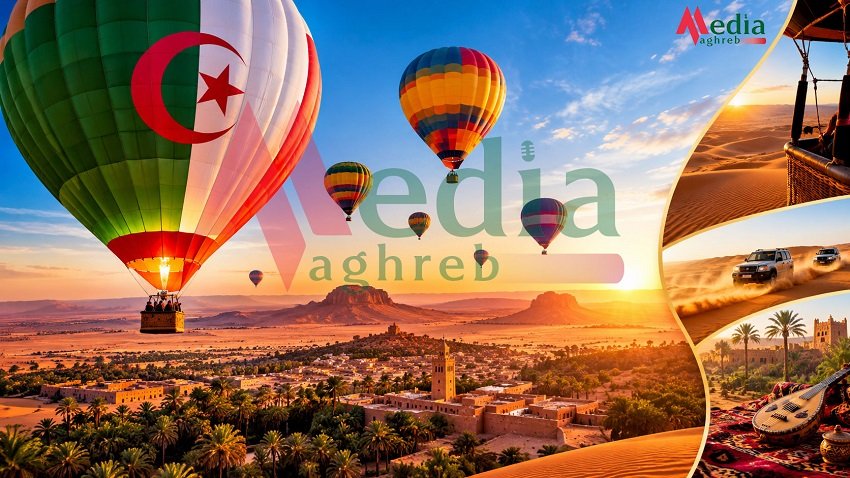
Hot Air Balloon Festival in Algeria’s Sahara: A New Window onto Tourism in the Sahel and Maghreb
The city of Timimoun, widely known as the “Red Oasis,” is preparing to host a new tourism experience in the Algerian Sahara with the launch of the first hot air balloon festival in Timimoun, scheduled to take place from October 28 to November 2, 2026. The event will add a new dimension to the tourism landscape of southern Algeria by bringing together the natural beauty of the desert, aerial sports, cultural activities and entertainment in an experience designed to present the Sahara from a different perspective—one that goes beyond traditional journeys through dunes, oases and ancient ksour. The initiative is particularly significant amid growing interest in desert tourism in Algeria, as the sector represents one of the areas capable of opening new opportunities for promoting the natural and cultural assets of the country’s south and connecting them with the broader tourism landscape of the Maghreb, the Sahel and Africa.
The choice of Timimoun for the festival appears to go beyond the introduction of another entertainment event to the desert calendar, as the Red Oasis offers a distinctive visual and cultural setting for such an initiative. The city is not simply a transit point in the Sahara, but a destination where sand dunes, oases, ancient ksour and tourism trails converge, creating an environment particularly suited to an event that connects the ground with the sky. Timimoun has already attracted growing attention through tourism and cultural events, including the International Desert Tourism Festival, which has provided visitors and guests with opportunities to explore some of the region’s landmarks, tourism routes and ancient ksour.
When the desert becomes an open-air stage in the sky
According to the announced program, the festival will begin on October 28 with the arrival of guests and the unveiling of a hot air balloon carrying the colors of the Algerian flag, alongside an evening musical performance. The following day will move into the event’s main aviation activities, featuring hot air balloon flights and giant kite displays, as well as a workshop for schoolchildren to build kites in cooperation with local associations and civil society organizations. In the evening, the program will feature a night-time balloon display, transforming the skies of Timimoun into an open visual space where illumination interacts with the surrounding desert landscape.
The experience will continue the following day with sunrise hot air balloon flights, involving professional pilots and accompanied by partner tourism agencies, alongside activities showcasing aerial sports and introducing visitors to this form of adventure tourism. The program will then move from the sky into the heart of the desert through an evening featuring a traditional desert atmosphere, dinner and overnight accommodation in camps among the dunes. This highlights the concept behind the festival: transforming a tourism trip into an integrated experience combining aviation, adventure, the environment, culture and desert hospitality, rather than limiting the visitor experience to a single destination or viewing a natural landscape from ground level.
From hot air balloons to the culture of the desert
The following day’s program expands to include four-wheel-drive excursions across the desert, entertainment activities, kite competitions and additional hot air balloon flights. The final day will feature another flight before the festival concludes with a closing evening combining balloons and celebratory performances. From a tourism perspective, this diversity highlights an attempt to build a tourism product that does not depend on a single attraction, but instead uses the desert itself as a platform for multiple activities capable of appealing to visitors interested in adventure, photography, aerial sports, local culture and environmental experiences.
The initiative comes in a city that has already demonstrated its ability to host cultural and tourism events with an international dimension. Timimoun has hosted the International Desert Tourism Festival as well as other cultural events linked to local identity, including the Ahallil Festival, which reflects an important part of the region’s musical and cultural heritage. This accumulated experience gives Timimoun an opportunity to build an integrated tourism profile based on the combination of heritage, natural landscapes, arts and modern activities.
Algerian desert tourism seeks new experiences
The hot air balloon festival comes at a time when desert tourism in Algeria is experiencing growing momentum, accompanied by continued official attention to evaluating the desert tourism season and developing activity across the southern provinces. A review meeting was held for the latest desert tourism season to present the sector’s performance and follow tourism-related activity, as part of a broader approach aimed at developing desert destinations and strengthening their appeal. This means that new events such as the hot air balloon festival can be viewed as part of a wider effort to diversify the tools used to promote southern Algeria and move desert tourism beyond its traditional association with overland excursions alone.
The significance of this approach extends beyond Timimoun itself, as southern Algeria encompasses a broad and diverse range of tourism destinations whose characteristics vary from one area to another. In Illizi, for example, the latest desert tourism season recorded notable visitor activity, while other southern regions have hosted sporting and tourism events that capitalize on the desert environment, including tourism rallies and aerial sports in El Menia. These experiences point to a growing trend toward linking desert tourism with sports and adventure activities, elements that can provide the Sahel, the Maghreb and Africa with broader opportunities to showcase their diverse desert landscapes.
From the ground to the sky: aerial sports enter the desert tourism landscape
What stands out about the new experience is that hot air balloons are not being introduced in isolation from the changes taking place in Algerian desert tourism. Rather, they intersect with a broader trend toward incorporating sports and aerial activities into the promotion of southern destinations. El Menia has hosted events combining tourism rallies and paragliding as part of efforts to highlight the region’s natural and tourism assets, particularly for visitors seeking adventure and unconventional activities. From this perspective, the Timimoun festival can be seen as another step toward using the sky itself as part of the desert tourism product.
Timimoun: a cultural destination alongside its natural appeal
Timimoun’s tourism strength is not limited to its dunes and natural scenery, but extends to the cultural heritage surrounding the oasis. The city hosts a range of artistic and cultural events, while Ahallil represents one of the most prominent elements of its cultural and musical identity. This gives new tourism initiatives an opportunity to engage with a local community possessing a rich cultural heritage capable of enriching the visitor experience. In this context, the hot air balloon festival appears to offer more than a spectacle in the sky; it creates an opportunity to combine the desert landscape with local culture, hospitality and the arts, giving the destination a distinctive identity within the tourism landscape of the Maghreb and Africa.
The hot air balloon festival as a gateway to digital promotion of Algeria’s desert
At a time when visual storytelling has become an important component of tourism decision-making, hot air balloons offer an additional advantage: the ability to present the desert landscape from a rare aerial perspective. This visual dimension could give Timimoun greater exposure across digital platforms, particularly as Algeria’s tourism sector has increasingly focused on strengthening digital promotion and marketing of desert destinations and encouraging content creators to participate in initiatives aimed at showcasing tourism areas.
The value of aerial imagery becomes even more significant when it comes to the desert, because the landscape seen from a hot air balloon is fundamentally different from the perspective offered by an overland journey. From above, the expanses of sand, oases, ksour and desert roads can appear within a single frame, creating visual content capable of connecting tourism with adventure, photography and content creation. Across Africa, where desert environments extend from the northern part of the continent into the Sahel, such experiences can contribute to presenting a different image of the desert—not simply as an arid geographical space, but as an environment of life, culture and tourism.
The Sahel and Maghreb: the desert as a cultural and tourism bridge
Talking about the Algerian Sahara cannot be separated geographically or culturally from the wider space stretching across the Maghreb, the Sahel and Africa. The desert is not merely a natural boundary; it is a historic space through which caravans traveled and within which communities interacted and diverse patterns of trade, culture and hospitality developed. From this perspective, modern tourism events can be viewed as contemporary tools for presenting this geographical space in a new way—one that combines heritage, innovation, travel and adventure.
Timimoun possesses an important advantage in this context: its ability to combine natural landscapes with local identity. Ancient ksour, tourism routes and cultural heritage provide visitors with an experience that extends beyond simply observing the dunes, while the hot air balloon festival introduces a modern element capable of attracting travelers seeking alternative forms of tourism. If this approach continues to develop, desert tourism could become increasingly diversified across the Maghreb, while creating broader opportunities for the Sahel and Africa to exchange tourism and cultural experiences.
Southern Algeria emerges as a platform for specialized events
In recent years, the Algerian Sahara has increasingly hosted events that go beyond the traditional tourism festival model, whether through aerial sports, cultural activities, artistic events or heritage-focused programs. The organization of the International Desert Tourism Festival in Timimoun, alongside other events in southern regions, points to an emerging approach aimed at developing a tourism calendar that transforms different Saharan provinces into venues for a variety of activities throughout the season. Authorities have also announced a new edition of the International Desert Tourism Festival in Adrar, underscoring the growing role of tourism events in southern Algeria.
Against this backdrop, the Timimoun hot air balloon festival appears to be part of a broader transformation in the concept of the desert tourism event. A modern festival does not necessarily have to be limited to an artistic performance or entertainment activity; it can create an integrated experience beginning with arrival at the destination, moving through aerial activities, desert excursions, cultural programs and overnight stays in camps, and culminating in evening celebrations. Each of these elements can become part of an integrated tourism narrative about the Algerian Sahara—a narrative with significant potential for digital distribution and for attracting regional tourism audiences.
An experience with economic and cultural dimensions
Although the hot air balloon festival has an obvious entertainment dimension, the impact of such events can extend to a wide range of tourism-related sectors, including transportation, accommodation, restaurants, tourism agencies, handicrafts and local services. When these components are combined with cultural and sporting activities, the event can become a platform connecting multiple economic activities in the same destination.
This aspect is particularly important in desert regions, where the ability to attract visitors often depends on the integration of the overall experience rather than on the presence of a single landmark. A visitor traveling to Timimoun for the balloon festival may also explore the oasis, ancient ksour, local culture and surrounding desert, extending the scope of the trip and giving the destination a greater opportunity to generate sustained visitor engagement. Previous tourism events in Timimoun have demonstrated the importance of tourism routes, landmarks and ancient ksour as key components of the visitor experience.
Toward a new image of tourism in Africa
From a broader perspective, this type of event could represent an important model for reshaping the image of desert tourism in Africa. The Sahara possesses enormous natural and cultural tourism potential, but tourism value does not depend solely on the existence of natural attractions. It also requires products and experiences that allow visitors to engage with those environments in different ways. Hot air balloons are one such tool, transforming the natural landscape into a personal and visual experience, particularly when combined with local culture, sporting activities and overnight stays in the desert.
In the Sahel, where development challenges intersect with the need to diversify economic activities and create new opportunities for local communities, tourism remains one of the sectors capable of benefiting from the promotion of natural and cultural heritage, while taking into account the particular circumstances and identity of each area. From this perspective, experiences emerging in the Algerian Sahara can become part of a broader conversation about the future of tourism across the Maghreb, the Sahel and Africa, particularly when they are built around environmental responsibility, local identity and the participation of local stakeholders.
Timimoun writes a new chapter in the skies of the Algerian Sahara
Ultimately, the appeal of the Timimoun hot air balloon festival lies not simply in the act of flying, but in the way it can transform the sky into a new window for discovering the desert. From the ground, visitors see dunes, oases and ancient ksour; from above, the perspective changes, revealing the desert as a vast landscape in which nature, people, culture and memory converge.
With the launch of its first edition in autumn 2026, Timimoun is entering a new tourism experience that adds to its existing portfolio of cultural and tourism events, at a time when Algeria is working to diversify tourism products in the south and strengthen the digital promotion of desert destinations. Between hot air balloons, giant kites, desert excursions, nights in camps and cultural activities, the central message is that the desert can serve as a living space for experience, discovery and innovation.
The balloon therefore rises not merely above Timimoun, but carries with it a new image of the Algerian Sahara—an image capable of finding its place within the broader tourism landscape of the Maghreb, the Sahel and Africa, where the desert possesses a unique ability to bring together the past and the future, heritage and technology, the stillness of the sands and the movement of adventure.
Above the Red Oasis, perhaps the most striking image will be the one that brings together the color of the sands below and the balloons above—a new tourism scene placing Timimoun at the forefront of discussion about innovative desert experiences and opening another chapter in the development of tourism in southern Algeria.
Share this content:




إرسال التعليق