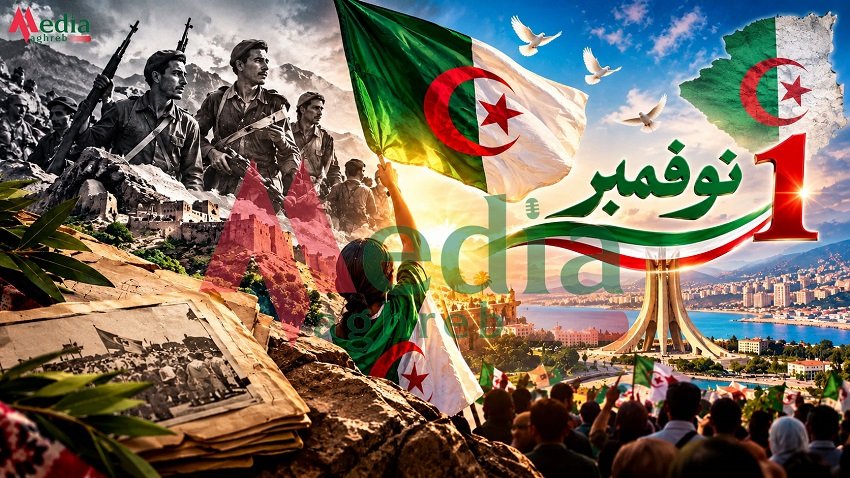
Algerian Revolution: The Epic Struggle That Changed History
From the historic meeting of the Six Leaders and the November 1 Declaration to the Evian Accords and independence in 1962, how Algeria’s liberation struggle became a defining chapter in the history of North Africa and Africa.
As Algeria marks the 72nd anniversary of the outbreak of its Liberation Revolution in 2026, November 1 remains one of the most significant dates in the country’s national history. It commemorates the moment when the Algerian people’s determination to end French colonial rule transformed into an organized armed struggle that would ultimately reshape the nation’s future and leave a lasting impact on the history of North Africa and the African continent.
More than seven decades after the historic events of 1954, the Algerian Revolution continues to represent a defining chapter in the broader struggle for freedom, national sovereignty and self-determination. Its legacy extends beyond the military confrontation itself, reflecting decades of resistance, political mobilization, organizational development and diplomatic efforts that culminated in Algeria’s independence on July 5, 1962.
The anniversary is therefore not merely an occasion to remember a historic event. It also provides an opportunity to revisit the circumstances that led to the revolution, the leadership decisions that shaped its beginnings, the sacrifices made throughout the struggle and the political transformations that eventually brought an end to colonial rule.
From National Resistance to the Decision to Launch the Revolution
The roots of the Algerian Revolution can be traced back to decades of resistance against French colonial rule. Throughout this period, Algerians pursued different forms of struggle, ranging from armed resistance during earlier historical periods to political activism, organizational work, journalism and reform movements.
During the first half of the twentieth century, the national movement gradually developed through political parties and organizations seeking to secure political and social rights, restore national identity and challenge a colonial system that denied Algerians the ability to exercise sovereignty over their own country.
One of the most decisive moments in this historical process came on May 8, 1945, when demonstrations in Sétif, Guelma and Kherrata were met with brutal repression. The massacres deeply affected national consciousness and exposed the severity of colonial violence against Algerian demands for freedom and political rights.
These events intensified discussions within the national movement about the effectiveness and limitations of political approaches. In the aftermath of the Second World War, growing numbers of activists became increasingly convinced that independence would require a fundamental change in the balance of power.
In 1947, the Special Organization, known as the Organisation Spéciale (OS), was established, representing an important stage in the development of clandestine activities within the national movement.
Later, political and organizational disagreements within the Movement for the Triumph of Democratic Liberties (MTLD) generated a serious internal crisis. This situation encouraged a group of activists to seek a new framework capable of overcoming divisions and preparing for armed struggle.
On March 23, 1954, the Revolutionary Committee of Unity and Action (CRUA) was established, becoming one of the key organizational foundations preceding the outbreak of the revolution.
The Six Historic Leaders: The Meeting That Prepared the Revolution
One of the most decisive moments preceding the Algerian Revolution took place on October 23, 1954, when six prominent figures of the national movement secretly gathered at the home of activist Mourad Boukechoura in the Raïs Hamidou district of Algiers, formerly known as La Pointe Pescade.
The meeting brought together six historic leaders: Mostefa Ben Boulaïd, Larbi Ben M’hidi, Mohamed Boudiaf, Krim Belkacem, Didouche Mourad and Rabah Bitat.
This gathering was far more than an ordinary organizational meeting. It represented a decisive step in preparing the armed uprising, agreeing on November 1, 1954, as the date for launching the revolution, establishing the National Liberation Front (FLN) and unifying efforts around the central objective of national independence.
The initiative reflected the determination of the six leaders to overcome the political and organizational disagreements that had weakened the national movement and move towards a more decisive confrontation with colonial rule.
The importance of this meeting also highlights the role of leadership and organization in transforming widespread public opposition into a structured political and military movement capable of sustaining a prolonged struggle.
Revolutions cannot be built on popular anger alone. They require clearly defined objectives, communication networks, the distribution of responsibilities and coordination between different groups operating on the ground.
In Algeria, the meeting of the Six Leaders formed part of a broader preparation process that paved the way for the historic events of November 1, 1954.
November 1, 1954: The Beginning of a New Historical Era
On November 1, 1954, Algeria entered a new chapter in its history as coordinated armed operations took place across several regions, targeting positions and interests associated with the French colonial authorities.
Although the groups involved in the initial operations possessed limited military resources, the uprising carried a clear political message: the struggle for Algerian independence had entered a new phase, moving beyond traditional political demands towards organized armed resistance.
The launch of the operations coincided with the publication of the November 1 Declaration, a document that established the political framework of the revolution and clearly articulated its central objective: restoring national sovereignty and establishing an independent Algerian state.
The declaration also called for national unity and sought to connect armed resistance with a broader liberation project that went beyond localized confrontations and presented a political vision for Algeria’s future.
Its historical significance extended far beyond the announcement of an armed uprising. The document became a fundamental reference for understanding the objectives and political principles of the revolution.
Independence was not presented simply as the withdrawal of colonial military forces. It was defined as the restoration of the Algerian people’s right to determine their own future, manage their national affairs and establish the institutions of an independent state.
The Soummam Congress and the Development of Revolutionary Institutions
As the Algerian Revolution progressed, sustaining the struggle required more sophisticated political and organizational structures.
On August 20, 1956, the Soummam Congress was held, marking a central turning point in the reorganization of the revolutionary movement and the development of its institutions.
The congress contributed to the establishment of the National Council of the Algerian Revolution (CNRA) and the Coordination and Execution Committee (CCE). It also introduced more structured approaches to managing the struggle and coordinating political and military activities.
These developments reflected the leadership’s understanding that confronting an organized colonial power required institutions capable of making strategic decisions, managing limited resources and coordinating operations across different regions.
They also strengthened the relationship between the revolutionary leadership operating inside Algeria and the movement’s activities abroad.
The revolution was consequently moving beyond its initial stage towards a more developed political and organizational framework capable of supporting its continued operations.
Another important milestone followed on September 19, 1958, with the establishment of the Provisional Government of the Algerian Republic (GPRA), headed by Ferhat Abbas.
The creation of the provisional government strengthened the political representation of the Algerian Revolution internationally. It provided the liberation movement with an institutional framework capable of representing the national cause, conducting diplomatic contacts and mobilizing international support for the Algerian people’s right to self-determination.
The Maghreb and Africa: A Revolution That Transcended Borders
The Algerian Revolution cannot be fully understood without considering its broader Maghreb and African context.
It emerged during a period when liberation movements were gaining momentum across different parts of the African continent, while societies living under colonial rule were increasingly demanding national sovereignty and political independence.
The intersection of these experiences helped highlight the regional dimension of Algeria’s struggle, which gradually extended beyond the confrontation between the National Liberation Front and the French authorities.
Geographical, social and political connections between Algeria and its neighboring countries formed an important part of the revolutionary experience.
The Algerian cause became associated with different forms of political, media and popular solidarity, as well as support networks extending beyond national borders.
Developments across North Africa also helped transform the colonial question into a regional issue that could no longer be viewed solely through the lens of French domestic politics.
At the African level, the Algerian Revolution formed part of a wider wave of liberation movements challenging colonial systems and demanding independence.
The internationalization of the Algerian question, including its inclusion on the United Nations agenda in 1955, expanded diplomatic opportunities to advocate for the Algerian people’s right to self-determination.
Consequently, the Algerian struggle became part of the international debate on decolonization and the political future of peoples living under colonial domination.
The revolution therefore represents a national Algerian experience in terms of its objectives, leadership and sacrifices, while also occupying an important place in the wider history of liberation, solidarity and political independence across Africa.
Understanding its regional dimension provides a clearer picture of how national liberation movements can extend beyond their borders when their objectives intersect with broader demands for freedom, dignity and sovereignty.
Internationalizing the Algerian Cause: From the Battlefield to Global Diplomacy
As the revolution continued, the conflict was no longer limited to military confrontations inside Algeria.
The National Liberation Front increasingly recognized the importance of diplomatic and media activities in presenting the Algerian cause to the international community, explaining the nature of its demands and securing support for the people’s right to determine their own political future.
One of the important milestones in this process came in September 1955, when the Algerian question was placed on the agenda of the United Nations.
This development allowed the issue to reach a wider international arena at a time when decolonization was transforming international relations and encouraging an increasing number of countries and peoples to question the legitimacy of continued colonial domination.
Towards the end of the 1950s, the political and economic costs of prolonging the war became increasingly significant subjects of discussion.
Within this context, the establishment of the Provisional Government of the Algerian Republic strengthened the political presence of the revolutionary movement, while armed resistance continued on the ground.
Diplomatic efforts also intensified in pursuit of a political settlement that would guarantee Algeria’s right to independence.
This combination of military resistance, political organization and international diplomacy became an essential dimension of the struggle that ultimately brought an end to French colonial rule.
The Evian Accords and Independence: The Birth of a Sovereign Algeria
After years of war, sacrifices and sustained resistance, negotiations between Algeria and France entered a decisive phase.
The process culminated in the signing of the Evian Accords on March 18, 1962.
A ceasefire was announced the following day, March 19, marking the beginning of a transitional period leading towards self-determination and the determination of Algeria’s political future.
On July 1, 1962, a referendum on self-determination was held, with the results demonstrating overwhelming support for independence.
On July 5 of the same year, Algeria officially declared its independence, bringing colonial rule to an end and opening a new chapter in the country’s history as a sovereign nation.
However, independence did not mean that the challenges facing the country had disappeared.
Instead, it marked the beginning of another historic mission: rebuilding state institutions, developing the national economy, expanding education, reorganizing political and social life and consolidating sovereignty over national decision-making.
After a prolonged war, Algeria faced the enormous task of transforming its liberation victory into a sustainable project of development and stability.
At the same time, preserving historical memory became an essential element of the country’s national identity and its understanding of the sacrifices that made independence possible.
The November Revolution in National Memory: Preserving History for Future Generations
As Algeria commemorates the 72nd anniversary of the outbreak of its Liberation Revolution, the importance of historical memory once again comes to the forefront.
Remembering November 1 should not be limited to ceremonial celebrations or the repetition of familiar historical images. It should also serve as an opportunity to deepen understanding of the country’s modern history and the complex process that led to independence.
Accurate historical documentation, preserving the testimonies of veterans and former fighters, making archival materials accessible to researchers and introducing younger generations to original historical documents are all essential elements in protecting national memory against simplification and confusion between established facts and historical interpretations.
The anniversary also provides an opportunity for a deeper examination of the liberation experience, including its organizational foundations, human sacrifices, political transformations and diplomatic achievements.
The history of the revolution cannot be reduced to the names of its leaders or the battles fought during the war.
It also encompasses the contributions of ordinary members of society, women, workers, students and the support networks that helped sustain the struggle throughout its different stages.
The Algerian Revolution remains one of the foundational events in the establishment of the modern Algerian state and a prominent milestone in the history of North Africa and Africa.
Remembering its anniversary is not only about honoring the achievements of the generation that fought for liberation. It is also about understanding the responsibilities that this historic experience places on the present: protecting national sovereignty, strengthening state institutions, safeguarding historical memory and transmitting the facts of the past to future generations with accuracy and integrity.
November 1, 1954, is therefore much more than a date in Algeria’s national calendar. It marks the beginning of a decisive liberation struggle that culminated in independence and became one of the defining events in the history of twentieth-century national liberation movements.
Media Maghreb Presents a Documentary on Algeria’s Historic Liberation Journey
In connection with the anniversary of the Algerian Revolution, Media Maghreb presents a short documentary film entitled “Algeria: The Story of a Revolution That Created Independence.”
Produced and developed by Media Maghreb, the documentary revisits the major stages of Algeria’s national liberation struggle, beginning with the historic meeting of the Six Leaders and the outbreak of the revolution on November 1, 1954, continuing through the years of resistance and sacrifice, and concluding with the declaration of independence on July 5, 1962.
The production makes use of artificial intelligence technologies to recreate visual scenes inspired by this decisive period in Algerian history.
Through this approach, the film combines historical storytelling with contemporary creative techniques, seeking to present the memory of the revolution to younger generations through an innovative visual experience.
The documentary reflects Media Maghreb’s interest in exploring new technologies and applying artificial intelligence to media production, while keeping historical events and national memory at the heart of its content.
By bringing together historical milestones and modern visual storytelling, the production offers audiences an opportunity to revisit one of the most important chapters in Algeria’s journey towards freedom and independence.
Watch the documentary: “Algeria: The Story of a Revolution That Created Independence.”
Media Maghreb – Remembering the past, documenting history and bringing its legacy to future generations.
Share this content:






إرسال التعليق