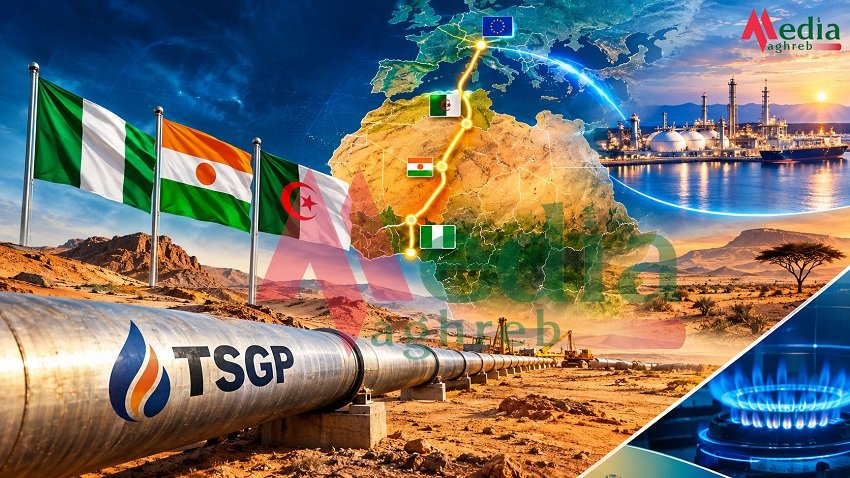
Trans-Saharan Gas Pipeline: A Project Reshaping the Energy Map of the Sahel and the Maghreb
The Trans-Saharan Gas Pipeline (TSGP) is no longer merely a long-term energy project designed to connect gas-producing regions in West Africa with international markets. In 2026, the project entered a new phase increasingly associated with actual implementation, following the approval of the updated final feasibility study and the official launch of construction works on the Algerian section of the pipeline. The development carries significance well beyond the energy sector, given the project’s position at the heart of the Sahel’s geographical map, its links to cross-border transport and infrastructure corridors, and its potential role in strengthening connectivity between West and North Africa and, ultimately, Europe’s energy networks.
The core concept of the project is to transport natural gas from Nigeria through Niger and into Algeria, where the new supplies can be connected to Algeria’s existing gas transmission, gathering, distribution and export infrastructure. This route places Algeria at the intersection of West Africa’s energy resources and infrastructure extending toward the Mediterranean, while giving Niger a pivotal position within an energy corridor running from the southern part of the African continent toward the north.
Why Is the Trans-Saharan Gas Pipeline Different?
The significance of the Trans-Saharan Gas Pipeline lies in the fact that it is not simply an isolated energy facility. Rather, it is connected to a broader network of existing infrastructure and continental projects aimed at improving connectivity across Africa. In Algeria, the project is linked to the Trans-Saharan Highway corridor and is planned to connect with the Hassi R’mel hub, allowing it to become part of Algeria’s national gas transmission system and existing export infrastructure. This gives the project a broader logistical dimension that extends beyond the simple transportation of gas from one point to another.
The African dimension of the project becomes even clearer when it is viewed within the wider framework of continental connectivity initiatives. The pipeline intersects strategically with the Trans-Saharan Highway and other infrastructure projects designed to strengthen links between Algeria and Nigeria. Collectively, these initiatives seek to reduce geographical isolation between North and West Africa and enhance the movement of trade, investment, energy and information across borders. In this context, the Trans-Saharan Gas Pipeline becomes part of a broader vision for developing economic corridors across Africa.
Algeria: An Energy Gateway Between the Sahel and the Mediterranean
Algeria occupies a central position in the Trans-Saharan Gas Pipeline project because of its extensive gas transportation, processing and export infrastructure, as well as its connection to European markets through the Mediterranean. According to information related to the Algerian section, the pipeline is expected to reach the Hassi R’mel hub before being integrated into Algeria’s national gas transmission network and export infrastructure. This gives the project the potential to benefit from an established energy system rather than requiring an entirely separate export chain to be built.
The importance of this role extends beyond Algeria itself and is linked to a broader question concerning the position of the Maghreb within Africa’s energy landscape. An established gas network in North Africa creates a more direct connection between gas resources in West Africa and Mediterranean markets, potentially increasing the importance of the Maghreb as an energy transit region between Africa and Europe. This is particularly relevant as European markets continue to pursue diversification of energy supplies and transportation routes.
The Sahel: Niger at the Heart of the Energy Corridor
If Algeria represents the northern gateway of the project, Niger constitutes the geographical link that gives the Trans-Saharan Gas Pipeline its continental character. The pipeline’s passage through Niger places the Sahel at the centre of an energy corridor connecting gas resources in West Africa with energy infrastructure in North Africa. As a result, the future of the project is closely linked to the ability of the participating countries to maintain technical and institutional coordination and create the conditions necessary for the construction of cross-border infrastructure.
Against this backdrop, 2026 witnessed significant movement along the Algeria-Niger track. In February, Algeria announced an agreement to launch work on the project across Nigerien territory. Follow-up efforts continued throughout the year, including a September visit by Algeria’s Minister of Hydrocarbons to Niamey to review bilateral cooperation projects, with the Trans-Saharan Gas Pipeline among the key files under discussion. These developments demonstrate that the project has become directly linked to the broader economic and energy cooperation agenda between Algeria and Niger, rather than remaining a stand-alone technical initiative.
From Feasibility Study to Construction: A Turning Point in 2026
The approval of the updated final feasibility study in Algeria in June 2026 represented a key milestone in the project’s development. The three participating countries agreed to adopt the study’s findings as a technical and economic reference for moving into subsequent stages, while also agreeing to complete the practical arrangements and procedures required for implementation. This development marked a shift from feasibility reassessment and intergovernmental coordination toward a phase increasingly focused on actual construction.
The day after the feasibility study was approved, an important field-level step followed with the official launch of construction works on the Algerian section in the Oulouf area of Adrar Province, in the presence of representatives from Algeria, Niger and Nigeria. The move is particularly significant because it marks the transition from studies, agreements and technical preparations to physical construction. After years of negotiations and feasibility assessments, the Trans-Saharan Gas Pipeline has therefore entered a phase in which implementation on the ground becomes the central measure of progress.
Trans-Saharan Gas Pipeline: A New Energy Artery for Africa
From an economic perspective, the project can be viewed as an attempt to reorganize the relationship between energy-producing regions and consumption and export markets across Africa. Nigeria has a major gas resource base, while Algeria possesses extensive gathering, transportation and export infrastructure. Niger, meanwhile, provides the geographical corridor connecting the two. The project therefore relies on the integration of different national strengths rather than placing the entire energy chain within a single country.
This is where the importance of the project for the Sahel becomes particularly evident. The region has long faced challenges related to insufficient cross-border infrastructure and limited connectivity. Investment in an energy corridor of this scale could indirectly stimulate the development of logistics, transportation, maintenance services and energy-related industrial activities. It could also create opportunities for local and regional companies to participate in supply chains and technical services. African energy institutions have highlighted the project’s potential links to employment, industrial development and economic growth in the countries along its route.
The Maghreb and a New African Energy Corridor
For the Maghreb, the Trans-Saharan Gas Pipeline introduces a new perspective on the region’s role within Africa’s energy map. Instead of relations with the Sahel being defined primarily by trade, borders or political cooperation, they could increasingly involve strategic infrastructure connecting energy resources in the south with export networks in the north. Such a transformation could give economic cooperation between North and West Africa a stronger long-term infrastructure dimension.
This comes at a time when energy has become increasingly connected to economic security and industrial competitiveness rather than simply the provision of fuel. Reliable gas transportation infrastructure can support industrial investment, gas-processing activities, electricity generation and other energy-related services. This makes connectivity projects between the Sahel and the Maghreb potentially relevant to sectors extending beyond hydrocarbons themselves. From this perspective, the Trans-Saharan Gas Pipeline could become part of a broader framework for rebuilding and expanding economic relations between North and West Africa.
Nigeria: Gas Resources Seeking a Route to the North
For Nigeria, the project represents an opportunity to connect its gas resources with new export networks through an overland route rather than relying exclusively on maritime transportation or a limited number of established markets. Strategically, reaching Algeria means gaining access to an energy network connected to the Mediterranean, potentially opening a different route for Nigerian gas to reach international markets. Nigerian authorities have repeatedly reaffirmed their commitment to advancing the Trans-Saharan Gas Pipeline, emphasizing the project’s importance for the participating countries and for Africa as a whole.
The significance extends beyond potential gas export revenues. Expanding gas infrastructure in West Africa could enable local economies to make greater use of their natural resources in industry and power generation while increasing domestic value creation. This issue is particularly important for Africa, a continent with substantial energy resources but persistent infrastructure challenges linking production centres with consumption markets.
Europe Looks South for Greater Supply Diversification
On the other side of the Mediterranean, the project is connected to the broader issue of diversifying Europe’s gas supply sources and transportation routes. European institutions have repeatedly identified diversification as a key element of energy security, while also highlighting the strategic importance of the Mediterranean and North Africa. Algeria, in particular, remains an important energy partner in Europe’s discussions on gas and other energy sources.
From this perspective, the Trans-Saharan Gas Pipeline should not be viewed solely as an internal African energy project. It could serve as a link connecting European energy markets with West African gas resources through North African infrastructure. This gives Algeria a potentially important position in the energy corridor between Africa and the Mediterranean, while placing the Sahel at the centre of an emerging equation involving development, infrastructure, energy and international trade.
The Sahel: Energy as a Driver of Development and Integration
The importance of the Trans-Saharan Gas Pipeline becomes more evident when it is considered against the infrastructure needs of the Sahel. Roads, railways, electricity grids, telecommunications networks and energy corridors can collectively contribute to creating a more integrated economic environment in which national borders represent less of a barrier to the movement of goods, services and investment. Within this framework, the project has been presented in African institutional discussions as a corridor capable of supporting regional integration and continental cooperation.
The relevance of this corridor is further enhanced by the geographical position of the Sahel as a bridge between West and North Africa. Any strategic infrastructure crossing this region can have effects extending beyond its primary function, provided that the necessary institutional, economic, technical and security conditions are in place to protect the facilities and ensure operational continuity. Consequently, the success of the Trans-Saharan Gas Pipeline will depend not only on laying the pipeline itself, but also on the participating countries’ ability to manage a long-term economic corridor involving multiple interests.
Algeria and Niger: Cooperation Beyond the Gas Pipeline
Recent developments also indicate that the Trans-Saharan Gas Pipeline is moving within a broader framework of Algerian-Nigerien cooperation in the energy sector. Bilateral discussions have included hydrocarbons, exploration and refining, alongside the continental gas project. This suggests a move toward a more comprehensive energy partnership and indicates that the pipeline could serve as a platform for expanding industrial and technical cooperation between countries in the region.
In September 2026, the Trans-Saharan Gas Pipeline once again moved to the forefront of discussions during the Algerian Minister of Hydrocarbons’ visit to Niger, which was conducted as part of efforts to follow up on bilateral cooperation projects. The development indicates that the next phase is no longer limited to announcing the project, but increasingly involves coordinating studies, procedures and preparations for the sections crossing Nigerien territory. Such a phase requires sustained cooperation among the technical institutions of all three participating countries.
Challenges Facing the Trans-Saharan Gas Pipeline
Despite the clear movement toward implementation, a cross-Saharan project of this complexity remains subject to a wide range of technical, logistical and institutional challenges. The route crosses vast geographical areas and requires continuous coordination among three countries and their national energy companies. It also requires the harmonization of technical standards, construction schedules and the integration of new infrastructure into existing networks. The approval of the updated feasibility study therefore does not mark the end of the challenges; rather, it provides the technical and economic foundation for entering a more detailed implementation phase.
The project’s long-term sustainability will also depend on an economic model capable of balancing the interests of producer countries, transit states, exporting countries and destination markets. Such a framework must support reliable gas flows while ensuring the continued development and maintenance of infrastructure. In this respect, the updated feasibility study adopted by the three countries represents an important step, as it provides a shared technical and economic reference for moving into subsequent stages.
An Energy Project or an African Economic Corridor?
The most important question surrounding the Trans-Saharan Gas Pipeline today is not simply how much gas could eventually move through it, but what impact the corridor could have on Africa’s economic map. If the pipeline is accompanied by industrial services, economic activity zones, transportation networks, maintenance facilities and vocational training, it could evolve from a gas transportation project into a broader development platform for the regions through which it passes. The African vision surrounding the project links it to wider objectives involving regional integration, natural-resource development and economic growth.
This is precisely where the project’s importance for the Sahel, the Maghreb and Africa becomes particularly clear. A corridor transporting gas from West Africa to North Africa could potentially serve as a model for other economic corridors linking coastal and landlocked regions while creating opportunities for projects in energy, transportation, telecommunications and industry. As continental connectivity expands, the Sahel could increasingly be viewed not simply as the geographical space separating North and West Africa, but as an economic bridge connecting the two regions.
Trans-Saharan Gas Pipeline Reshapes the Maghreb’s Position in Africa
Current developments are giving energy an increasingly important role in reshaping economic relations between the Maghreb and the Sahel. Algeria, given its geographical position and energy infrastructure, can potentially serve as a link between West African energy resources and Mediterranean markets. Niger can play the role of a transit hub at the heart of the Sahel, while Nigeria remains the principal resource base for the gas feeding the project. In this sense, the Trans-Saharan Gas Pipeline brings together three distinct African regions within a single energy system.
With the project now entering the implementation phase, attention is shifting toward the ability of the three countries to maintain the momentum achieved during 2026 and translate agreements and feasibility studies into sustained progress across all sections of the pipeline. The next stage will be increasingly defined by construction, technical coordination and project management on the ground. These factors will determine how quickly the continental vision can be transformed into functioning infrastructure. Recent official developments indicate that coordination between Algeria, Niger and Nigeria is continuing and that the project has become a significant component of energy cooperation among the participating countries.
From the Sahara to the Mediterranean: A New Route for Africa
Ultimately, the Trans-Saharan Gas Pipeline represents more than a natural gas transportation line. It reflects a changing approach to infrastructure development in Africa, moving from projects contained largely within national borders toward cross-border corridors based on the integration of resources, markets and transportation networks. From the Sahel to the Maghreb, this type of infrastructure could contribute to building a more interconnected economic system if accompanied by local development, institutional cooperation and investment in complementary infrastructure.
With construction beginning on the Algerian section and the updated feasibility study approved, the Trans-Saharan Gas Pipeline now faces a fundamentally different test from its previous stages: the test of implementation, integration and eventual operation. If the three countries succeed in completing the technical and institutional phases, the project could become one of Africa’s most significant energy corridors, giving the Sahel a new role in energy flows between the western and northern parts of the continent while strengthening the Maghreb’s position as a bridge between African and Mediterranean markets.
In this equation, gas is no longer the project’s only defining element. Infrastructure, economic integration and African cooperation increasingly represent the broader story of a corridor stretching from West Africa to the Mediterranean.
Share this content:







إرسال التعليق