Burkina Faso’s Economy: From Sahel Gold to a Production Economy and Investment Opportunities in Africa
Burkina Faso’s economy stands at a critical stage in its modern development. Located in the heart of the African Sahel, the country possesses economic assets that extend far beyond the traditional image of gold and agriculture. At the same time, it faces challenges related to security, energy, infrastructure, financing, limited industrialization and high transport costs. These factors will determine its ability to transform natural resources into sustainable value creation and long-term employment opportunities.
Recent international assessments published in 2026 indicate that the economy has shown notable resilience, supported by stronger performances in mining, agriculture and services. The central challenge is no longer maintaining economic activity, but building a more diversified productive base capable of generating jobs, particularly for young people.
Economic Growth Driven by Agriculture, Mining and Services
Burkina Faso maintained growth momentum during 2025 despite persistent regional and security challenges. According to international institutions, real GDP growth reached approximately 5.3% in 2025, compared with 4.8% in 2024. Services, agriculture and mining were the main contributors. Favorable weather conditions and government support measures boosted agricultural output, while mining benefited from sector reforms and higher gold prices.
Gold: A Strategic Resource Seeking Greater Value Addition
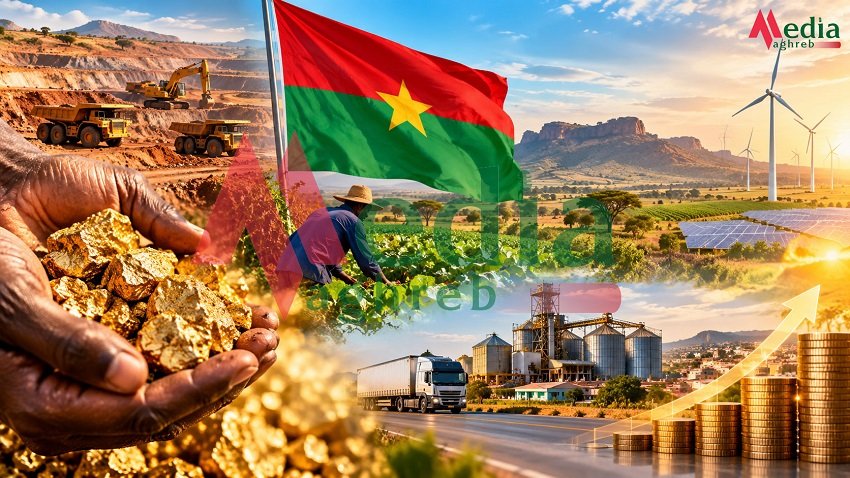
Gold remains the cornerstone of Burkina Faso’s economy. Recent policy direction has focused on moving beyond raw-resource exports toward increasing the share of economic value retained by the state and local communities.
Mining reforms have deepened through the adoption of a new mining code, the restructuring of relations between the state and investors, and stronger public-sector involvement in resource management. Authorities have also increased national control over certain industrial mines and promoted local expertise and suppliers.
A major milestone was the inauguration of the country’s first gold refinery, reflecting a strategy aimed at processing a larger share of production domestically instead of exporting raw materials. If accompanied by stronger governance and supply-chain development, this move could stimulate financial, logistical and industrial activities linked to the mining sector.
Agriculture: The Sector Closest to the Real Economy
While mining remains a key source of foreign currency earnings, agriculture continues to represent the broad foundation of Burkina Faso’s economy and society. In March 2026, the World Bank approved a $215.9 million project to support agricultural transformation, focusing on rice and maize value chains, productivity improvements, processing infrastructure and market access.
The real transformation opportunity lies not only in increasing production but also in developing integrated value chains covering storage, processing, packaging, transportation, marketing and financing. Such an approach can reduce losses, raise farmers’ incomes and create jobs beyond the farm sector itself.
Food Security and New Market Opportunities
Food security remains a major concern across the Sahel due to climate variability, transportation costs and limited market access. Burkina Faso is exploring opportunities to diversify production and strengthen self-sufficiency. Efforts to expand local cultivation into new products, including pineapple production, reflect broader ambitions to reduce import dependence and support agricultural commercialization.
Energy: The Decisive Factor for Industrialization
The future of Burkina Faso’s economy cannot be discussed without addressing energy. Limited electricity supply and high production costs continue to constrain industry, modern agriculture and digital services.
International Monetary Fund studies indicate that Burkina Faso still relies heavily on imported electricity. Reforms are therefore focused on increasing domestic generation, expanding solar power, strengthening transmission networks and extending rural electrification.
The country’s geography and climate offer significant potential for solar energy development. Beyond electricity generation, renewable energy can support irrigation, agricultural cooling systems, storage facilities, food processing and digital services in rural areas.
Infrastructure and Transport
As a landlocked country, Burkina Faso depends heavily on transport corridors linking it to ports and regional markets. Investments in roads, railways, logistics hubs, warehouses and border facilities are essential to lowering trade costs and improving competitiveness.
The National Development Program for 2026–2030 places infrastructure, sustainable economic transformation, industrialization, energy, transport and communications among its leading priorities.
Economic Integration within the Alliance of Sahel States
Economic cooperation among Burkina Faso, Mali and Niger has become one of the most significant developments in the regional landscape. The three countries are working to translate political cooperation into deeper industrial, commercial and economic integration through the Confederation of Sahel States.
Private Sector Opportunities
One of the key determinants of Burkina Faso’s future economic trajectory will be the ability of reforms to stimulate private-sector growth. Government investment can build infrastructure, but sustainable job creation requires dynamic private enterprises.
Opportunities exist in food processing, logistics, solar energy, digital services, mining-support industries, storage, transport, financial services, domestic tourism and professional services. These sectors could strengthen job creation and reduce dependence on raw-material exports.
Fiscal Reform and Long-Term Investment
Recent fiscal reforms have focused on reducing budget deficits, improving public financial management, strengthening governance, expanding the tax base and improving debt management. The objective is not merely expenditure control but also better allocation of resources toward infrastructure, education, health, energy and agriculture.
What Does This Mean for North Africa and the Sahel?
The growing economic connection between North Africa and the African Sahel could become increasingly important in the coming years through trade, transport, energy, services and investment. Improved commercial corridors and a stronger business environment could create new opportunities for agricultural and mineral exports while opening markets for regional companies.
A Window of Opportunity
Burkina Faso’s economic story cannot be reduced to gold alone, nor measured solely through growth rates. The country’s future will depend on its ability to transform mining resources into value-added industries, connect agriculture with manufacturing, expand energy capacity, improve infrastructure, support private-sector development and strengthen regional trade.
If these reforms succeed, Burkina Faso could evolve from a resource-extraction economy into a more diversified production-based economy, turning its strategic location in the African Sahel from a geographical challenge into a long-term economic advantage.
Share this content:





إرسال التعليق