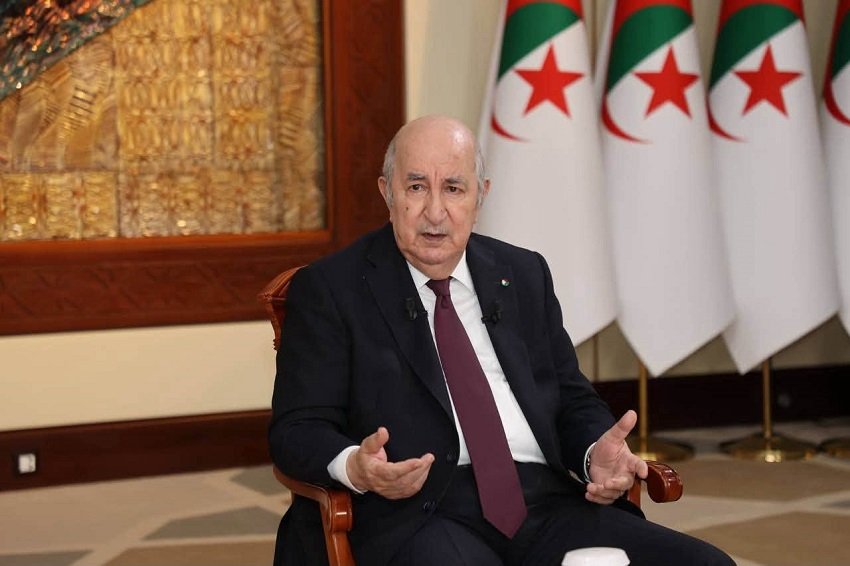
Tebboune Maps Out Algeria’s Next Development Milestones
President Abdelmadjid Tebboune used his latest periodic media meeting to present a broad overview of Algeria’s economic, social, diplomatic and political priorities, highlighting the country’s development trajectory and the objectives set for the coming years.
The meeting covered a wide range of issues, including economic growth, investment, industrial development, energy policy, foreign-exchange management, agriculture, wages, purchasing power, housing, water security, infrastructure, digitalization, the fight against corruption, foreign relations, regional security and local governance.
Throughout his remarks, the President emphasized the need to consolidate Algeria’s development achievements and establish a long-term economic and institutional trajectory capable of serving future generations.
Economic Growth and the $400 Billion Target
President Tebboune said the latest International Monetary Fund report was consistent with the economic outlook previously established by Algeria.
He described the national economy as being built on a solid foundation and said that reaching a gross domestic product of $400 billion could become possible during the first quarter of 2027.
He also indicated that Algeria’s economic growth rate would exceed 3.8%, with the possibility of reaching approximately 4.02%.
According to the President, the development objectives established for 2027 are designed to move Algeria toward what he described as a “point of no return” in development, meaning a stage at which the country’s economic and development trajectory becomes firmly established.
Building Stable Non-Hydrocarbon Revenues
A central element of the economic strategy outlined by the President is the expansion of revenues generated outside the hydrocarbons sector.
Tebboune said Algeria’s plan aims to establish stable non-hydrocarbon income of at least $50 billion.
He also stated that the national economy is moving toward a free-market model while maintaining guarantees designed to protect poorer and vulnerable segments of society.
The President called on the private sector, which he said currently obtains approximately 90% of its financing from public banks, to contribute to the creation of private banks.
This approach, he indicated, would support a broader and more diversified financial and economic environment.
Foreign Currency and Import Controls
Tebboune stressed that Algeria would not return to the practice of inflated invoices under any circumstances.
He also warned that reducing invoice values could be used as another method of transferring foreign currency illegally.
The President emphasized that rationalizing foreign-currency expenditure is intended to protect Algeria’s foreign-exchange reserves and safeguard national economic sovereignty.
He cited the example of Algerian dates allegedly being sold abroad for around 40 dinars, while their price on the domestic market could reach approximately 700 dinars.
The remarks formed part of a wider discussion about controlling financial practices, directing foreign currency toward productive activities and protecting national resources.
Digitalization and the Fight Against Irregularities
Digital transformation was highlighted as one of the mechanisms that has enabled Algerian authorities to identify irregular practices more effectively.
President Tebboune said Algeria had made significant progress in digitalization, allowing authorities to uncover a number of irregularities that would ultimately be referred to the judiciary.
He referred specifically to 581 companies that had allegedly declared false information and used a single address in the same building in Ouled Fayet.
He also cited approximately 200 companies allegedly using the same serial number with social security services.
The President said corruption had declined considerably, while acknowledging the continued presence of forces seeking to obstruct state institutions.
Investment and the Single-Window System
The single-window mechanism was described by Tebboune as a strong indicator of investment dynamism across Algeria.
He said the successful completion of 20,000 investment projects would represent evidence of renewed confidence in the Algerian economy.
The President also reiterated that investments from Arab countries are welcome, while referring to an exception that he said was already known.
In another economic sector, he said part of Algeria’s integrated phosphate production would be directed toward exports, while another part would be used to produce phosphate fertilizers.
Major Infrastructure Projects
The President also reviewed a number of major infrastructure projects currently under development.
The expansion of Annaba Port is expected to be completed toward the end of the first quarter of 2027.
In the water sector, Tebboune said the remaining seawater desalination projects had reached approximately 70% completion. Once all of the projects become operational, they are expected to cover around 62% of Algeria’s drinking-water needs.
He also announced measures to accelerate construction of the Algiers–Tamanrasset railway, with work being carried out from three different locations simultaneously.
The financing of the project, according to the President, came through an offer from the African Development Bank, of which Algeria is a member.
Energy Policy and Regional Connectivity
On energy policy, President Tebboune stressed that Algeria would not engage in what he described as reckless behavior in energy markets and would continue to support consensus.
He said fewer than 1,000 kilometers remained to connect the trans-Mediterranean pipeline.
The President also described the gas pipeline project linking Nigeria to Europe through Niger and Algeria as realistic from a European perspective.
He characterized the Trans-Saharan Gas Pipeline as a strategic project linking Africa with Europe while benefiting Nigeria and Niger.
The project was presented within the broader context of Algeria’s role in regional energy infrastructure and its efforts to strengthen links between African producers and European markets.
Industrial Development and Algerian Steel
Industrial development also featured in the President’s remarks.
Tebboune said Algerian steel will be used in the manufacturing of Fiat vehicles, highlighting the role of domestic industrial inputs in supporting local manufacturing.
At the same time, he criticized some industrialists for importing luxury vehicles instead of importing the equipment and requirements needed for their factories.
The issue was linked to the broader objective of rationalizing foreign-currency expenditure and ensuring that imports contribute to productive economic activity.
Wages and Purchasing Power
The President addressed wage policy and social protection, stressing that increases in wages and allowances should result from higher revenues and development programs in order to avoid inflation.
He confirmed that a 53% increase in wages in 2027 would be implemented either in one payment or two installments, depending on Algeria’s financial circumstances.
Tebboune also stressed that protecting purchasing power remains a state priority.
He said citizens have the right to complain about high prices and reaffirmed that the government would take measures to protect their purchasing power.
Agriculture and Rising Prices
The President devoted significant attention to agriculture and the increase in prices.
He identified what he described as greed and greenhouse cultivation in provinces affected by fires among the factors that contributed to rising prices.
At the same time, he stressed that preliminary investigations showed that the majority of farmers were not responsible for the increase in prices.
Tebboune instructed the government to take action against speculation and said prices would fall noticeably.
He also warned those proven to be involved in speculation that they would have to assume responsibility, stressing that attempts to provoke social tension through the food needs of Algerians would be mistaken.
A comprehensive assessment of the agricultural sector is expected during the first half of 2027, while the state will continue strengthening its regulatory role in agriculture.
Wildfires and Compensation
The President said many of the recent fires had been deliberately caused.
He also announced that compensation provided so far had reached 1,200 billion centimes.
The issue was addressed alongside agricultural production and food prices, given the effects of fires on agricultural areas and local economic activity.
Housing Achievements
Tebboune said Algeria had succeeded in delivering more than two million housing units, describing this figure as higher than the commitments previously established.
He linked the housing program to the country’s long-term social commitments and described it as part of Algeria’s fulfillment of its responsibilities toward the memory of the martyrs.
Science and Algerian Experts Abroad
The President also spoke about the importance of scientific expertise and the contribution of Algerian scientists living abroad.
He said meetings with Algerian scientists aim to connect the country more closely with developments in global science.
According to Tebboune, Algeria has entered a new development phase that requires the contribution of its scientists abroad and greater use of their expertise and international experience.
Algeria’s Diplomatic Approach
On foreign policy, the President stressed Algeria’s identity as a peaceful country and said it is prepared to contribute to mediation when requested.
He described Algeria as a country that promotes stability and said this approach had contributed to major powers respecting its positions.
Tebboune also stressed that Algeria would maintain its relations with Russia, China and the United States, saying the country would not give up its friendships with any of these three powers.
Western Sahara
The President reaffirmed Algeria’s position regarding the Western Sahara issue.
He said that no one could impose the disappearance of the Sahrawi people from the map and referred to United Nations Security Council resolutions concerning the issue.
He also stated that Algeria and Mauritania have observer status in the Western Sahara issue.
Tebboune reiterated that Algeria does not claim to be “more Sahrawi than the Sahrawis themselves” and said Algeria supports any decision accepted by the Sahrawis themselves.
Development as the Key to Sahel Stability
The situation in the Sahel was another major component of the President’s remarks.
Tebboune argued that stability in the Sahel should be achieved through development rather than militarization, stressing that poverty provides an environment in which disorder and terrorism can thrive.
Regarding Niger, he said Algeria would protect its interests and emphasized the shared interests between the two countries.
He described Algeria’s position toward Niger as one based on common interests and regional considerations.
The President also addressed Algeria’s relationship with Mali, stressing that despite the geographical proximity between the two countries, Algeria does not interfere in Mali’s internal affairs.
He said Algeria supports both Mali and Niger in combating terrorist groups.
Security and Regional Cooperation
Tebboune also addressed the deployment of Algerian aircraft toward Niger, presenting it as the consequence of what he described as the conduct of certain parties rather than a change in the constitutional doctrine governing the Algerian Army.
He emphasized Algeria’s commitment to defending its interests and its regional partnerships.
The President also referred to the Movement for Oneness and Jihad in West Africa (MUJAO), accusing an unnamed state of creating the organization and recalling that the group had been responsible for the killing of Algerian diplomats before disappearing.
Relations With the United Arab Emirates
The President also addressed Algeria’s position toward the United Arab Emirates, saying that Algeria would not retreat from its position and that the rupture in relations had occurred after tensions had reached what he described as a critical point.
He invoked Algeria’s history of sacrifice for independence and emphasized that the country would not be subjected to pressure that undermines its sovereignty.
Political Dialogue and Local Elections
On domestic political affairs, Tebboune said dialogue with political parties would involve those represented in Parliament.
He also addressed the issue of capital punishment, saying parties opposed to its implementation should confront the Algerian public with their position.
The President described Algeria as being engaged in a war against drugs, arguing that drug trafficking seeks to undermine the country.
He noted that some countries apply the death penalty in drug-related cases and stressed that any execution sentence is implemented only after all avenues of appeal have been exhausted.
He also strongly condemned child kidnapping, describing it as a serious crime unacceptable to society.
Municipalities and Youth Participation
Tebboune called on political parties and youth organizations to recognize that local administration begins at the municipal level.
He said municipalities now have greater resources and capabilities following the revision of the Municipal Law.
The President urged the current generation to assume responsibilities similar to those undertaken by previous generations, noting what he described as reluctance among some young people to run in local elections.
He expressed particular hope of seeing university-educated young people leading municipalities.
Development in the Shadow Areas
The President said approximately eight million Algerians had benefited from programs targeting so-called shadow areas.
He also criticized what he described as outdated local administrative practices, declaring that the era of the “Aghas and Bashaghas” had ended and saying this mentality had led him to dismiss a number of local officials.
The broader objective, he said, is to reach a point from which Algeria’s development process cannot be reversed during the remainder of his term.
Planning for a Population of 70 Million
Tebboune stressed the importance of planning for Algeria’s long-term demographic and economic future.
He said previous generations had planted so that later generations could benefit, adding that the current generation should similarly invest in the future.
He called for Algeria to become a state that continuously advances development rather than returning to the starting point.
The President said an advanced state is one that establishes long-term development horizons and indicated that Algeria is already thinking about a future in which its population reaches 70 million people.
He noted that Algeria is currently recording an annual population increase of approximately one million people, making long-term planning for infrastructure, housing, employment, water, energy and public services increasingly important.
The Symbolism of Emir Abdelkader
The President concluded his remarks on a historical and national dimension by addressing the continuing presence of Emir Abdelkader in presidential activities.
He said Emir Abdelkader was imposed by Algerian history and that his recurring presence in presidential activities reflects the figure’s profound symbolic importance.
The reference places the historical figure within the broader national narrative that links Algeria’s past sacrifices with its current development ambitions.
A Broad Vision for Algeria’s Future
Taken together, the President’s statements presented a broad vision extending from economic diversification and infrastructure development to social protection, investment, energy security, digitalization and regional diplomacy.
The objectives outlined for the coming period include strengthening non-hydrocarbon revenues, attracting investment, expanding industrial capacity, improving agricultural regulation, protecting purchasing power, accelerating major infrastructure projects and increasing the role of technology and digitalization.
At the same time, the President linked Algeria’s domestic development agenda to its regional and international role, particularly in energy, the Sahel and relations with major global powers.
The central message of the meeting was the need to consolidate Algeria’s development trajectory and establish long-term foundations capable of supporting a growing population and ensuring that development continues from one generation to the next.
Share this content:


إرسال التعليق