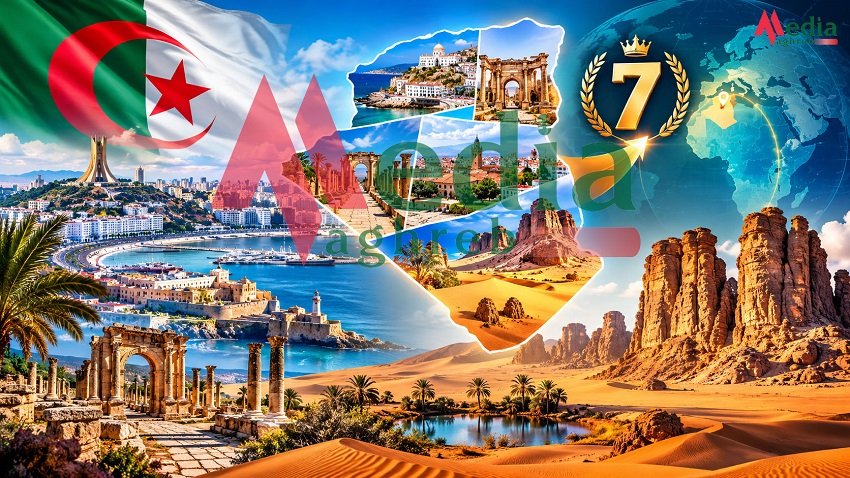
Algeria on the Global Tourism Map: From Oran’s Seventh-Place Ranking to the Treasures of the Sahara and the African Sahel
Algeria is gradually moving beyond its traditional image as a major energy producer and North African country to emerge as a destination with significant tourism potential. Stretching from the Mediterranean coastline to the depths of the Sahara, the country combines historic cities, Roman archaeological sites, Islamic and Ottoman heritage, Mediterranean landscapes and some of the world’s most extraordinary desert environments.
The country’s growing visibility on the international tourism map was reinforced in 2026 when Oran was selected by The New York Times for its annual 52 Places to Go list. Oran ranked seventh among the 52 destinations highlighted by the American newspaper for 2026, placing an Algerian city alongside major international destinations. The selection highlighted Oran’s Mediterranean character, cultural revival, architectural heritage and status as the birthplace of rai music.
The significance of Oran’s appearance on the list goes beyond a single international ranking. It comes at a time when Algeria is receiving increasing attention from international travel publications and tourism specialists, reflecting a broader shift in perceptions of the country as a destination. For Algeria, this renewed attention has potential economic implications, particularly for hospitality, transport, cultural tourism, restaurants, local crafts, entertainment and private investment.
Oran’s appeal is closely connected to its location on the Mediterranean and its combination of history and contemporary cultural life. The city has Ottoman, Spanish and French architectural influences, while its modern identity remains strongly associated with rai music and an active cultural and entertainment scene. The New York Times specifically highlighted the city’s restored Regional Theatre, its seafront, Art Deco balconies, cafés, galleries and outdoor concerts.
Oran: A Mediterranean City With Growing International Visibility
Oran occupies a distinctive position in Algeria’s tourism landscape because it brings together several components that increasingly influence international travel demand: coastal tourism, cultural heritage, entertainment, architecture and gastronomy.
Its Mediterranean waterfront provides a natural foundation for tourism development, while the city’s historic buildings and cultural institutions offer opportunities to expand beyond the traditional summer beach season. The restoration of cultural landmarks and the growing visibility of Oran’s artistic scene also strengthen its potential to attract visitors interested in culture rather than conventional seaside tourism alone.
The international attention surrounding Oran is therefore relevant from an economic perspective. Tourism development can generate demand across a wide network of activities, including hotels, restaurants, transportation, tour operators, cultural venues, retail businesses and handicrafts. The broader the tourism product becomes, the greater the possibility of extending visitor spending across the local economy rather than concentrating it in a single seasonal activity.
The fact that Oran appeared seventh in the New York Times’ 52 Places to Go in 2026 should nevertheless be understood correctly: it is a position within that specific annual selection of 52 destinations, rather than a universal statistical ranking of every city in the world.
Timgad: Algeria’s Roman Heritage as an International Tourism Asset
If Oran represents the new cultural and Mediterranean face of Algerian tourism, Timgad represents one of the country’s strongest historical assets.
The ancient Roman city, located near Batna in the Aurès region, was founded under Emperor Trajan around 100 AD. Its remarkably preserved urban structure reflects Roman planning principles, with a distinctive grid layout and monumental public buildings. Timgad is also listed as a UNESCO World Heritage Site, making it part of Algeria’s internationally recognized cultural heritage portfolio.
Timgad’s tourism potential lies not only in its archaeological importance but also in its ability to connect several tourism markets. Visitors interested in Roman history, Mediterranean civilization, archaeology and cultural heritage can combine Timgad with other destinations in eastern Algeria, creating longer itineraries and greater economic value for surrounding communities.
International travel guides have increasingly drawn attention to the site. Lonely Planet placed Timgad first in its editorial list of the 10 Best Places to Visit in Algeria, describing it as one of the finest Roman archaeological sites in the country. This should be understood as a ranking within Lonely Planet’s Algeria travel guide, not as a global ranking of cities or destinations.
Constantine: A City Built Around Geography and History
Constantine offers a completely different tourism model. Known for its dramatic position above deep ravines and its famous bridges, the eastern Algerian city combines spectacular geography with a long historical legacy.
The city’s distinctive landscape has become one of its strongest tourism assets. Its historic quarters, the Palace of Ahmed Bey, the National Museum and the Emir Abdelkader Mosque contribute to a cultural tourism product that can be marketed alongside archaeological sites in the wider eastern region.
Lonely Planet placed Constantine second in its list of the best places to visit in Algeria, following Timgad and ahead of Annaba. Again, this is an editorial ranking within a guide devoted to Algeria rather than a global ranking of Constantine.
From an economic perspective, Constantine demonstrates how urban heritage can support tourism beyond traditional coastal destinations. Historic architecture, museums, guided tours, cultural events, restaurants and accommodation can collectively create a tourism ecosystem capable of generating value throughout the year.
Algiers: The Capital as the Gateway to Algeria
Algiers remains central to any strategy aimed at expanding international tourism in Algeria. As the country’s capital and principal international gateway, it is where many foreign visitors begin their journey.
The Casbah is perhaps the most recognizable component of the city’s historic identity. Its narrow streets, traditional houses, palaces, mosques and hillside setting provide an urban heritage experience that differs significantly from Algeria’s Roman ruins or Saharan landscapes.
The city also offers a broader architectural mix reflecting different historical periods, including Ottoman, Islamic, French colonial and post-independence structures. The Martyrs’ Memorial, the Jardin d’Essai, the Bardo Museum and Notre-Dame d’Afrique add further dimensions to the capital’s tourism offer. Lonely Planet describes Algiers as a city whose architecture reflects the country’s complex history and recommends spending more than a brief stopover in the capital.
For the tourism economy, Algiers has another important advantage: connectivity. International flights, domestic transport links, hotels, restaurants and business infrastructure make the capital a natural hub from which visitors can travel toward the Mediterranean coast, the Roman archaeological sites and the Sahara.
Annaba and Tlemcen: Heritage Beyond the Better-Known Destinations
Annaba represents another important dimension of Algeria’s tourism potential. The city is associated with the ancient Roman settlement of Hippo Regius and with St. Augustine, one of the most influential figures in early Christian intellectual history.
The archaeological remains of Hippo Regius, together with the Basilica of St. Augustine and Annaba’s Mediterranean setting, give the city a distinctive combination of religious, historical and coastal tourism assets. Lonely Planet included Annaba among its leading Algerian destinations and highlighted its connection with St. Augustine and its seaside character.
Tlemcen, meanwhile, represents Algeria’s medieval architectural heritage. The city developed as a major center of learning, trade and culture and contains important Islamic architectural landmarks, including the Great Mosque and the El Mechouar complex. Its historical links with Fez, Tunis and Granada underline the broader cultural networks that once connected the Maghreb and the Mediterranean.
Such destinations are particularly important for strengthening the tourism economy because they allow Algeria to build a diversified national tourism product rather than relying exclusively on beaches or major cities.
Djemila and the Economic Value of Roman Heritage
Djemila, the ancient Roman city of Cuicul, is another major component of Algeria’s heritage tourism potential. Located in a mountainous setting near Sétif, the site is recognized by UNESCO for its exceptional Roman remains.
The archaeological site contains temples, forums, basilicas, arches and extensive mosaics. Its location also creates opportunities to connect heritage tourism with mountain landscapes and local cultural experiences.
UNESCO lists Djemila alongside Timgad, Tipasa, the Kasbah of Algiers, the M’Zab Valley and other Algerian sites. Algeria currently has seven properties inscribed on the World Heritage List, including six cultural properties and one mixed natural-cultural property, Tassili n’Ajjer.
This concentration of internationally recognized heritage provides Algeria with a significant competitive asset within North Africa and the wider Maghreb. The challenge is to convert international recognition into sustainable visitor flows, longer stays, stronger local spending and greater private-sector participation.
The Sahara: Algeria’s Largest Untapped Tourism Opportunity
Perhaps no element of Algeria’s tourism offer is more strategically significant than the Sahara.
The Algerian Sahara covers an enormous portion of the country and includes landscapes ranging from vast sand seas and oasis towns to volcanic mountains, rock formations and prehistoric archaeological sites. Destinations such as Timimoun, Tamanrasset, Djanet and the Tassili n’Ajjer region provide a tourism experience that is fundamentally different from the Mediterranean north.
Tassili n’Ajjer is particularly important. UNESCO describes it as a vast plateau in southeastern Algeria, extending toward the borders with Libya, Niger and Mali, and containing one of the world’s most important concentrations of prehistoric rock art. More than 15,000 drawings and engravings document environmental changes, animal migrations and human life around the Sahara over thousands of years.
The economic potential of Saharan tourism extends beyond hotels. It includes desert excursions, local guides, transportation, handicrafts, cultural tourism, ecological tourism, adventure tourism and community-based tourism. If developed sustainably, these activities can distribute tourism revenues across remote communities and create employment outside Algeria’s traditional urban economic centers.
Lonely Planet has also highlighted destinations such as Tassili n’Ajjer, Timimoun and Tamanrasset as important components of Algeria’s tourism offer, particularly for travelers seeking desert landscapes and experiences beyond conventional mass tourism.
Algeria, the Maghreb and the African Sahel
Algeria’s tourism development should also be viewed within the broader geographical and economic context of the Maghreb and Africa.
The country occupies a strategic position between the Mediterranean, the Maghreb and the wider African interior. Its southern borders connect it geographically with the broader Sahelian space, while its northern coastline links it to Europe and the Mediterranean tourism market.
It is important, however, to distinguish between Algeria’s geographic and strategic links to the African Sahel and the narrower definition of the Sahel as the semi-arid belt south of the Sahara. Algeria is generally classified as a North African and Maghreb country rather than as a core Sahel state.
This distinction does not diminish the country’s relevance to the African Sahel. Algeria’s geographical position, transport networks, diplomatic role and proximity to countries such as Mali and Niger give it a broader regional significance. Tourism could become one component of a wider economic relationship linking North Africa with the African interior.
For the Maghreb as a whole, Algeria’s emergence as a tourism destination could also contribute to a more diversified regional tourism economy. The Maghreb possesses Mediterranean beaches, Roman heritage, Islamic architecture, desert landscapes and distinctive culinary traditions, creating opportunities for complementary tourism circuits across North Africa.
Tourism as an Emerging Economic Diversification Tool
For Algeria, the expansion of tourism carries an economic significance that goes beyond visitor numbers.
The sector can support employment in hospitality, transport, food services, entertainment, cultural industries, handicrafts and travel services. It can also stimulate investment in airports, roads, hotels, digital booking platforms, museums and cultural sites.
International recognition can play a role in this process by increasing destination visibility and encouraging travelers to consider Algeria alongside more established Mediterranean markets.
The growing number of international travel publications featuring Algeria suggests that the country’s tourism story is increasingly reaching audiences outside the traditional regional market. Lonely Planet’s recent Algeria coverage, for example, highlights the country’s coastline, Roman ruins, historic cities and Sahara landscapes, while its destination guide describes Algeria as a country combining Mediterranean geography with the vastness of the Sahara.
The Challenge: Turning Recognition Into Sustainable Tourism Growth
International recognition alone cannot transform Algeria into a major tourism economy. The next stage requires a stronger connection between global visibility and the practical infrastructure needed to accommodate visitors.
Visa procedures, international air connectivity, hotel capacity, transport between destinations, multilingual tourism services, digital booking systems, professional tour guides and the preservation of archaeological sites all influence the competitiveness of a destination.
The geographical size of Algeria is both an advantage and a challenge. A traveler can move from Mediterranean coastal cities to Roman archaeological sites and then into the Sahara, but the distances involved require efficient domestic transport and carefully designed tourism circuits.
Lonely Planet notes that Algeria’s vast territory means travelers often need domestic flights or other forms of transport to move efficiently between northern cities and deep-Sahara destinations.
The development model must also protect the heritage that makes Algeria attractive in the first place. UNESCO-listed archaeological sites and fragile desert environments require conservation, controlled visitor management and sustainable infrastructure.
A Broader Tourism Future for Algeria
The story of Algerian tourism in 2026 is therefore not limited to Oran’s appearance at No. 7 in The New York Times’ 52 Places to Go. That recognition is one visible sign of a broader process.
From Oran’s Mediterranean cultural revival to the Roman streets of Timgad and Djemila, from Constantine’s dramatic ravines to Algiers’ Casbah, from Annaba’s connection with St. Augustine to Tlemcen’s medieval heritage, Algeria possesses an unusually diversified tourism portfolio.
Further south, the Sahara adds another layer of international appeal. Tassili n’Ajjer, Tamanrasset, Djanet and Timimoun offer landscapes and cultural experiences that cannot easily be replicated elsewhere.
For the Maghreb and Africa, Algeria’s tourism potential is significant because it adds another major destination to a region already rich in cultural and natural assets. Its proximity to the African Sahel also gives the country a potentially important role in linking North African tourism markets with broader African economic and cultural networks.
The central question is no longer whether Algeria possesses the tourism assets required to attract international visitors. The country’s historical, cultural and natural resources provide substantial evidence that it does.
The more important question is how effectively Algeria can convert those assets into a sustainable tourism industry capable of generating employment, attracting investment, extending visitor stays, supporting local businesses and strengthening the country’s position within the international tourism economy.
If that transition succeeds, Algeria could gradually move from being a destination known primarily to regional travelers and specialist explorers to becoming a more visible component of the global tourism market. The combination of Mediterranean cities, Maghreb heritage, Roman civilization, Saharan landscapes and proximity to the African Sahel gives the country a tourism profile with considerable economic potential.
In that sense, Oran’s seventh-place position in the New York Times 52 Places to Go 2026 list may be viewed not as an isolated achievement, but as part of a wider international rediscovery of Algeria — a country whose tourism economy still has considerable room for expansion across the Maghreb, the African Sahel and Africa as a whole.
Share this content:






إرسال التعليق