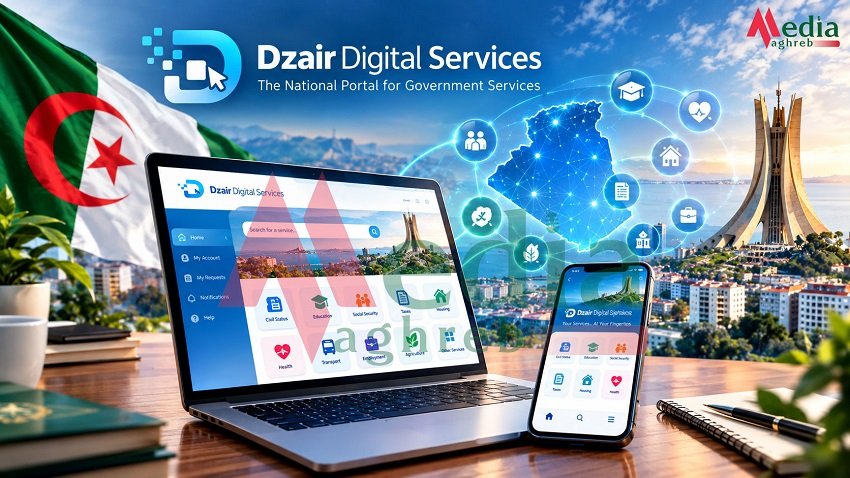
Algeria’s Digital Transformation: One Million Users on Government Services Portal in Two and a Half Months
Digital transformation in Algeria is no longer merely a headline within plans to modernize public administration. It is gradually becoming a reality experienced by citizens in their daily dealings with government institutions.
In the latest indication of this transformation, Algerian authorities announced that the national government digital services portal, “Dzair Digital Services,” recorded one million registered users within no more than two and a half months of its official launch on July 5, 2026, while the number of visitors exceeded five million during the same period.
The figure is significant because of the short period in which it was achieved. At the same time, however, it requires careful interpretation that distinguishes between the number of registered users and the number of visits, so that digital indicators do not become misleading when assessing the actual reach and use of the service.
What stands out in the Algerian experience is that the portal was not introduced simply as another government website. Rather, it was designed as a unified interface for public digital services, seeking to bring together services provided by different government sectors within a single system.
This reduces the need for citizens to know the website of every ministry or institution and search across dozens of separate platforms for the service they need. From this perspective, the importance of the project goes beyond the technical dimension to the restructuring of the relationship between the administration and citizens, moving from a model in which citizens travel to government offices to obtain services toward a model in which services become more accessible to users through a unified digital space.
From 21 Services to 150 Services
When the national digital services portal was officially launched in July 2026, it began with 21 public services, before the system expanded rapidly.
By September, authorities announced that the number of services available through the portal had reached 150 digital services, reflecting a clear direction to transform the portal from a limited launch platform into a broad national infrastructure for electronic government services.
This rapid expansion within a short period is one of the clearest indicators that the main objective was not merely to create a digital interface, but to build a scalable system capable of continuously incorporating services from different sectors.
The increase becomes even more significant when considering the nature of the services being integrated. Expansion has not been limited to a single sector, but has extended to areas directly connected to citizens’ daily lives, including education, water resources, taxation, youth, associations, pilgrimage and public works, in addition to other government and digital services.
One recent example is the inclusion of the “Parents’ Space” within the portal, providing access to a digital service linked to students’ educational careers. This reflects an effort to bring frequently used citizen services into a single access point.
In the water sector, services with a direct impact on daily life have also been added, including applications for connection to the drinking water network and applications for connection to sanitation networks, as well as a professional service related to qualification and classification certificates.
These services highlight an important shift in the concept of digitalization. The real value does not simply lie in transferring a paper-based process into an electronic format, but in enabling citizens or businesses to submit applications, track them remotely, reduce travel and processing times, and improve the traceability of transactions.
The portal has also added new services related to the tax sector, including a tax schedule extract, a tax non-liability certificate, a certificate of existence, and a tax identification number certificate for individuals.
These services are particularly important for citizens, businesses and economic operators because the digitalization of tax documents and procedures can reduce the time and costs associated with travelling between government offices, while potentially improving the flow of transactions between public administration and economic operators.
One Million Users: What Does the Figure Tell Us?
Reaching one million registered users within two and a half months provides an early indication of the scale of demand for government digital services in Algeria.
However, an accurate journalistic reading of the figure requires avoiding confusion between the number of people who registered and used the platform and the number of citizens who uniquely used at least one service.
The official statement used the expression “one million registered users,” while it also reported more than five million visitors to the portal since its launch.
The two figures therefore measure different indicators and, by themselves, do not make it possible to determine the number of unique citizens who completed digital transactions or the average number of transactions per user.
Nevertheless, exceeding five million visits within a short period is an important indication that the portal has attracted significant attention, particularly given that the project is relatively new and that its service base was expanding progressively during the same period.
The figure becomes more meaningful as additional services continue to be introduced, because greater service diversity means that citizens may have repeated reasons to return to the platform, rather than visits being linked to a single procedure or a specific seasonal requirement.
From a political and administrative perspective, the transformation carries another significance. Digitalization has become part of a broader project to reform public administration and improve the performance of public services, rather than simply a technical upgrade.
At a Council of Ministers meeting in July 2026, emphasis was placed on achieving full sectoral interconnection within a specified timeframe to facilitate the use of digital services, alongside intensifying efforts to accelerate the expansion of digital services, amid the uptake recorded by the new system and the entry into service of the national data center.
What Does Algeria Want from the Portal?
The stated objective goes beyond making documents or applications available online.
The government’s plan places the portal within a broader path aimed at reducing citizens’ travel, simplifying procedures, improving transparency and raising the quality of public services.
In May 2026, the government discussed the portal’s deployment plan, emphasizing the expansion of services through both web and mobile versions in order to directly reduce travel, simplify procedures and improve administrative transparency.
This highlights one of the most important turning points in the project: the success of digital government should not be measured by the number of government websites or the number of services carrying the label “digital,” but by the extent to which citizens can complete transactions from beginning to end without returning to paper-based procedures.
If a user can submit an application, attach documents, pay fees when necessary, track the file and receive the result electronically, then digitalization represents a genuine transformation in public service delivery.
If, however, a website merely provides information or allows users to download a form before requiring them to visit a government office, the impact remains considerably more limited.
Interoperability: The Biggest Test
For this reason, the concept of “interoperability between sectors” appears to be one of the most important terms in the future of Algeria’s digital portal.
Ultimately, citizens do not want to know which ministry holds the data they need. They want to complete their transaction. The more effectively government systems can exchange data in a secure and lawful manner, the less citizens will need to submit the same document to multiple authorities.
Algeria is moving in this direction through digital infrastructure that includes data centers, sovereign cloud computing and a sovereign network connecting ministerial sectors and national institutions.
This infrastructure is intended to provide a technical foundation for linking services rather than leaving them as separate digital islands. Statements by officials indicate that unified access to services is being developed in parallel with the expansion of the number of services.
This means that the next phase could be more important than the launch phase itself. The challenge is no longer to prove that the state can create a portal, but to ensure that the services available on it are interconnected, stable, user-friendly and capable of being adopted across different government administrations.
What Does the Citizen Gain?
For citizens, the most visible impact could be the saving of time and reduction in travel.
In a geographically vast country such as Algeria, travelling to a government office does not necessarily mean a few additional minutes. For residents of remote areas, it can involve a long journey, transportation costs and absence from work or education.
Every service that can be completed remotely therefore represents a reduction in both individual and social costs.
Digital services can also give citizens greater ability to track their transactions rather than relying entirely on in-person inquiries. When the application process becomes electronically documented, it creates a higher level of traceability, which is also linked to transparency and reducing direct interaction between service applicants and government employees.
Authorities have reinforced this aspect by launching the 3017 hotline for portal users, with the aim of responding to inquiries and concerns related to digital services.
The existence of a support channel directly associated with the platform is an important element because the transition to digital administration cannot succeed through technology alone. It also requires mechanisms to assist users who encounter difficulties with registration, access or completion of transactions.
Most-Requested Services: What Do the Numbers Tell Us?
An important data gap remains at this stage.
Despite the announcement of one million registered users and more than five million visitors, no official statistical table reviewed for this report has been identified that specifies, for example, the number of visits to civil status, taxation, education or housing services and ranks them according to the number of visits or completed transactions.
Therefore, publishing a list titled “the 10 most-visited services” accompanied by specific figures would be inaccurate unless the High Commission for Digitalization officially releases such data.
Independent guidance platforms do publish lists describing certain services as “the most requested.” These may include birth certificates, unemployment benefits, social security, digital identity, housing services and the baccalaureate. However, such lists are not official statistics on activity by users of the national portal and should not be treated as a government-documented ranking.
Accordingly, it can be said more cautiously that services related to personal documents, education, social security, employment, housing and taxation appear to be among the areas most likely to attract mass usage.
However, this conclusion should not be converted into an official numerical ranking before detailed data are published by the authority overseeing the portal.
From E-Administration to a Digital State
The Algerian project takes on a broader political and administrative dimension when placed within the digitalization process that preceded the launch of Dzair Digital Services.
In December 2022, the government launched a government portal for digitized public services that at the time included more than 300 services linked to 29 ministerial sectors, with information and services available around the clock.
The new portal therefore represents another stage within a broader government digitalization process, with a stronger focus on integration, unified access and national digital services infrastructure.
This transition is important because the traditional challenge facing e-government projects is not always the absence of digital services, but their fragmentation.
A ministry may offer one electronic service, a public institution another, and a local authority a third, while citizens remain responsible for identifying which authority provides the service, finding its website and understanding how to access it.
The unified platform seeks to address this problem by shifting the experience from “searching for the administration” to “searching for the service.”
The Infrastructure Behind the Digital Platform
The portal’s success cannot be separated from investments in digital infrastructure.
The announcement of a national data center, sovereign cloud computing and a sovereign network linking sectors reflects an effort to build a national layer capable of hosting and processing government data and services within a more integrated environment.
This also relates to digital sovereignty, which has become increasingly important in government policies as countries expand their reliance on cloud services and digital data.
Infrastructure alone, however, is not enough.
As the number of services expands, the importance of information security, personal data protection, service continuity and the ability to withstand pressure will increase. There must also be clear mechanisms for restoring services in the event of technical failures.
All these elements will become more sensitive as increasingly important services move from traditional offices to the digital portal.
Citizens Outside Major Cities Face a Different Test
The success of digitalization also remains linked to the digital divide.
Algeria has made significant progress in telecommunications and smartphone use, but citizens’ ability to benefit from electronic services is not necessarily equal across regions, age groups and social categories.
For this reason, awareness campaigns organized by the High Commission for Digitalization, including open information days designed to familiarize citizens with new services, represent a complementary component of the technical project.
A service that citizens do not know exists cannot achieve its intended impact, regardless of its technical efficiency.
What Comes After One Million?
One million users represents a first stage, not an endpoint.
The real test for the portal will be its ability to move from a large number of registered users to a larger number of transactions completed digitally, from separate services to interconnected services, and from simply providing a service to improving the citizen’s entire experience.
The announced plan points to the continued addition of services, the digitalization of more procedures and stronger interoperability between sectors, as part of the broader objective of building a “Digital Algeria 2030.”
The increase from 21 services at launch to 150 services also demonstrates that expansion is taking place rapidly. This will expose the system to growing challenges related to stability, security, capacity and user experience.
Perhaps the most influential step in the next phase will be the transition from digitizing services to redesigning services.
Instead of simply transferring paper-based procedures onto a digital screen, government agencies can redesign the entire process so that institutions exchange data they already possess and citizens are no longer required to provide information that is already held by the state.
A New Indicator of a Changing Citizen-Government Relationship
Ultimately, the figure of one million registered users and more than five million visitors in less than three months provides a clear indication of the level of interest in the platform, but it does not by itself constitute a final assessment of the success of the digital government experience.
More important will be what future data reveal about the number of transactions completed entirely online, usage rates for individual services, system failure rates, application processing times, the volume of documents accepted electronically and the extent to which government agencies recognize these documents without requiring citizens to obtain paper copies again.
If Algeria succeeds in turning these indicators into an integrated service system, the impact of the project will extend beyond making it easier to obtain a document or submit an application.
It could contribute to reshaping the relationship between citizens and government, reducing administrative costs, improving transaction traceability, supporting transparency, enhancing the business and investment environment and reducing pressure on traditional government facilities.
For citizens, however, the measure of success remains much simpler: Can they complete their transaction from their phone or computer, at any time, without making an additional trip to a government office and without repeatedly submitting the same documents?
The answer to this question will ultimately determine whether the one million users represent merely a striking figure at the beginning of a new digital project or the beginning of a deeper transformation in how the Algerian state delivers public services.
Against this backdrop, the expansion from 21 to 150 services, together with the continued integration of new services covering education, taxation, water resources, pilgrimage, youth and public works, represents a path that could make the portal one of the key components of Algeria’s digital state infrastructure in the coming years.
The publication of detailed official statistics on the most-used services, the number of completed transactions, success rates and processing times remains an essential step toward evaluating digital transformation with greater accuracy and transparency, and toward turning visitor and registration figures into measurable indicators of public service quality.
Confirmed Data as of September 21, 2026
Official launch date: July 5, 2026.
Registered users: One million registered users.
Number of visitors: More than 5 million visitors.
Number of services at launch: 21 services.
Number of services announced in September: 150 services.
Announced objective: Expand services, digitize additional procedures and strengthen interoperability between sectors.
Strategic horizon: Support the transition toward “Digital Algeria 2030.”
User support service: 3017 hotline.
Share this content:













إرسال التعليق