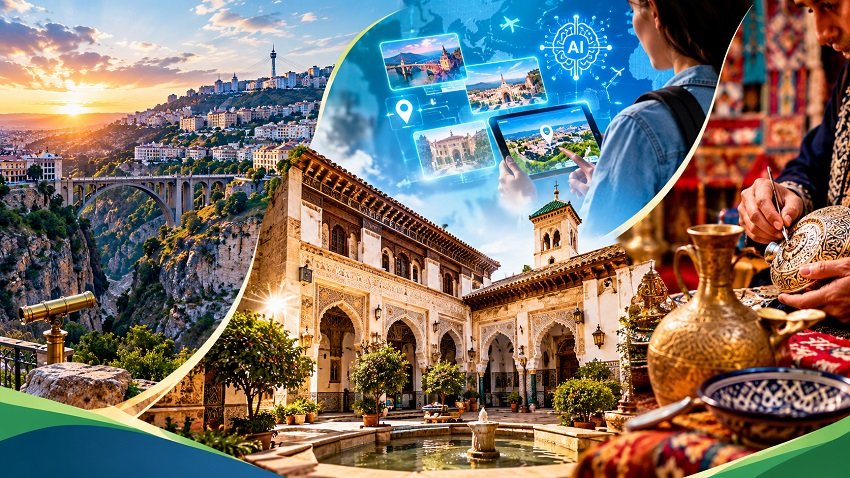
Constantine Opens the Door to Digital Tourism: From Ahmed Bey Palace to Artificial Intelligence and a New Map for Algeria’s Tourism Destination
In a city that has long condensed its history into bridges suspended above deep gorges, palaces preserving the memory of successive eras, and markets and crafts that carry the details of everyday life from one generation to another, Constantine is now entering a new chapter in its tourism story.
This new chapter is not only about what visitors can see with their own eyes, but also about how they can discover the city before arriving, the tools that can help them understand its history and culture, and the ability to transform its heritage into a modern and sustainable tourism experience.
World Tourism Day in Constantine
The World Tourism Day celebrations in Constantine are taking place from September 24 to 28, 2026, coinciding with the approach of World Tourism Day on September 27 each year.
The event comes within a global context that has chosen for 2026 a theme closely connected to the transformation currently taking place in the travel and tourism industry: “The Digital Agenda and Artificial Intelligence to Redesign Tourism.”
The choice of this theme reflects a shift in the global tourism debate from merely using technology to improve tourism services toward reconsidering how the tourism experience itself can be redesigned through data, digital platforms and artificial intelligence, while keeping people, local communities and cultural identity at the heart of the process.
Tourism and Handicrafts Exhibition at Ahmed Bey Palace
In Constantine, this transformation is taking a clear local form through a tourism and handicrafts exhibition organized by the Directorate of Tourism and Handicrafts of Constantine Province in coordination with the Chamber of Traditional Crafts and Handicrafts and the National Public Museum of Traditional Arts and Cultural Expressions at the El Hadj Ahmed Bey Palace.
The event brings together various stakeholders in the sector and is being hosted by the palace from September 24 to 28.
The initiative does not appear to be merely a ceremonial activity linked to an international occasion. It comes at a time when Constantine is experiencing increased tourism activity, with groups of foreign tourists arriving to explore its historical, cultural and craft attractions.
This makes the event not only a platform for exhibition and promotion, but also an opportunity to assess the ability of the Constantine destination to present itself in a more integrated manner.
Handicrafts as Part of the Tourism Product
One notable feature of the event’s program is that traditional crafts and handicrafts are not presented as a secondary element alongside tourism attractions, but rather as an integral component of the tourism product itself.
A tourist visiting a city with such historical depth does not necessarily seek only a building or a landscape. Visitors are also interested in the story of the place, its cuisine, crafts, lifestyles, products they can take home and the cultural memories that remain with them after departure.
From this perspective, integrating artisans and local producers into the tourism ecosystem can help connect tourism spending to the local economy while creating broader opportunities for small businesses, craftspeople and young entrepreneurs.
Tourism as Part of Algeria’s Economic Diversification Strategy
This aspect gains additional importance in light of Algeria’s efforts in recent years to make tourism one of the pillars of economic diversification, with an emphasis on improving the quality of tourism supply, supporting domestic tourism, developing inbound tourism, encouraging investment, upgrading services and human resources, and expanding digitalization across the sector.
These directions are part of a 2026–2028 action plan aimed at building a higher-quality and more authentic tourism offering and creating opportunities for investment and employment, while giving digital transformation and training a central role in the development of the sector.
Constantine and the Potential of Cultural Tourism
Against this backdrop, Constantine possesses characteristics that make it one of Algeria’s important cultural tourism destinations.
The city is among the oldest cities in the world, with roots dating back to the Phoenician era, when it was known as Cirta and served as the capital of the Numidian Kingdom. It subsequently passed through Roman, Islamic, Ottoman and colonial periods, leaving layers of history reflected in its urban fabric, landmarks and cultural memory.
The old city was included in the national cultural heritage inventory in December 2004, while Constantine has also attracted international attention in the fields of heritage preservation, management and the valorization of cultural resources.
Ahmed Bey Palace: An Artistic and Cultural Memory
This is where the importance of Ahmed Bey Palace becomes particularly evident.
The palace is not simply a historical building that can be included in a conventional sightseeing itinerary. It is a space that captures an important part of Constantine’s history and artistic and cultural memory.
The current events gain additional significance from the fact that the National Public Museum of Traditional Arts and Cultural Expressions at Ahmed Bey Palace received nearly 15,000 visitors and tourists during the first half of 2026, including visitors from different Algerian provinces and from abroad.
This points to continued interest in the site as a cultural and tourism attraction.
Cultural Heritage and the Creation of Tourism Demand
The flow of visitors to Ahmed Bey Palace highlights an important aspect of Algeria’s tourism landscape: cultural heritage remains capable of generating tourism demand when it is presented effectively.
Historical attractions may have existed for centuries, but their economic and tourism value is not determined by age alone. Their value also depends on their ability to reach audiences, offer an understandable and engaging experience, and connect with the other components of the destination, including accommodation, restaurants, transportation, guiding services, handicrafts and cultural events.
This is precisely where digital tourism can play an increasingly important role.
Digital Transformation and Sustainable Tourism
Against this backdrop, the intellectual forum scheduled alongside the Constantine exhibition on September 27 under the title “Digital Transformation and Sustainable Tourism: Toward a Digital Strategy to Strengthen the National Destination” comes at a time when the issue extends beyond the event itself.
The theme reflects the transformation taking place within Algeria’s tourism sector through the introduction of booking platforms and digital services, efforts to make tourism services more accessible through technology, and support for startups and innovative solutions in tourism promotion.
Online Booking Platforms in Algeria
In 2025, Algeria announced the continuation of work on developing an electronic booking platform covering units affiliated with the Hotel, Tourism and Thermalism Management Group, alongside efforts to establish a digital booking platform bringing together public and private hotels.
The objective is to provide tourists with access to a wider range of services related to accommodation, restaurants and other tourism services.
These steps demonstrate that digitalization in Algerian tourism is no longer limited to promotional communication. It is gradually moving toward services, booking and the digital integration of different components of the tourism experience.
Artificial Intelligence and the Redesign of the Tourism Experience
Digital transformation in tourism, however, does not end with creating a website or booking platform.
The next stage will increasingly depend on destinations’ ability to manage data, understand visitor patterns, provide multilingual content, direct tourists toward lesser-known attractions and experiences, facilitate movement between landmarks, and connect tourism companies, artisans, guides and service providers within an integrated ecosystem.
This is where artificial intelligence emerges as a tool capable of changing the way tourism decisions are made, from the initial search for a destination to designing an itinerary, providing recommendations and managing resources.
The Global Message of World Tourism Day 2026
At the international level, the United Nations message marking World Tourism Day 2026 points to the fact that artificial intelligence is already changing the way travelers select destinations, how tourism businesses operate and how travel experiences are designed.
At the same time, this technological transformation raises concerns about the possibility of concentrating tourism flows around a limited number of destinations and platforms.
This makes investment in digital skills, broader access to technology and ensuring that local communities benefit from digital transformation essential elements of the future of tourism.
Using Technology to Distribute Tourism Activity in Constantine
Constantine could benefit from technology not only to attract more visitors to its best-known sites, but also to distribute tourism activity across a wider network of experiences.
Instead of limiting a visitor’s itinerary to a small number of landmarks, smart platforms could recommend routes connecting historical sites, museums, markets, handicrafts, restaurants and cultural events.
Such platforms could enable visitors to discover details that may not appear in traditional tourism itineraries.
Artificial intelligence tools could also provide information in multiple languages, an important advantage for destinations seeking to attract international visitors from diverse markets.
The Tour Guide Between Technology and Human Expertise
This transformation is also closely connected to the role of the tour guide, who remains a central human element even in highly technology-driven tourism models.
During 2026, Algeria began monitoring a digital platform project for tour guides, while emphasizing the importance of guides as a direct interface reflecting Algeria’s image to visitors.
The authorities have also stressed the need to develop professional skills and continuous training in line with changes in the sector.
This balance between technology and human expertise appears essential to ensure that digital transformation does not replace human knowledge, but rather strengthens it and expands its impact.
“IA Tour Algérie 2026” and Tourism Innovation
In May 2026, digital transformation and artificial intelligence gained a more prominent position in Algeria’s tourism policy through the launch of the national innovation competition for smart promotion of Algerian tourism, “IA Tour Algérie 2026.”
The initiative seeks to encourage the development of digital solutions using artificial intelligence and virtual reality to enhance Algeria’s tourism appeal and develop new promotional tools.
This indicates that the state is not treating artificial intelligence as a technology detached from the tourism sector. Instead, it is opening space for students, researchers, startups and innovators to develop applications and solutions specifically connected to tourism.
Tourism and Its Impact on the Local Economy
From an economic perspective, the importance of this transformation extends beyond tourist numbers alone.
When a tourist stays in a hotel, uses transportation, eats at a restaurant, visits a museum, purchases a handicraft product or hires a local guide, the trip becomes a chain of economic activities benefiting a broad range of stakeholders.
This is why sustainable tourism is fundamentally linked to a destination’s ability to retain a greater share of tourism-generated economic value within the local community while protecting the cultural and natural resources that form the foundation of tourism appeal.
Heritage Management and Tourism Development
This approach is consistent with the concept of sustainable tourism, which seeks to integrate heritage management and tourism development at the destination level, protect cultural and natural assets, and involve different stakeholders in planning and decision-making.
In historic cities in particular, the equation becomes more sensitive.
An increase in visitor numbers can create economic opportunities, but it also requires responsible management to protect the urban fabric, identity and heritage sites from pressures resulting from intensive use.
Constantine and the Integrated Urban Tourism Experience
Constantine has an important advantage in this regard: its cultural tourism does not depend on a single landmark.
The old city, bridges, palaces, museums, crafts, historical memory and modern urban expansion are all elements that can be incorporated into a single tourism experience.
This diversity creates significant opportunities for technology to develop interactive maps, smart routes, virtual reality experiences, audio guides and multilingual digital content presenting the history of different sites, with information that can be updated continuously.
Technology as a Solution to Visitor Challenges
The success of this transformation, however, will not be measured by the number of applications or platforms launched, but by their ability to solve real problems faced by visitors and the tourism sector.
Travelers want to know where to go, how to get there, how long the journey will take, what they can see, where they can stay, what services are available, how to make payments and what languages are supported.
The more effectively this information can be brought together in a clear and reliable digital experience, the greater the destination’s ability to compete in a tourism market where travel decisions often begin long before the visitor reaches the airport.
Algeria’s 2026–2028 Tourism Plan
This need comes at a time when Algeria is seeking to strengthen its ability to attract tourists and develop domestic tourism.
Under the Ministry of Tourism and Handicrafts’ 2026–2028 action plan, Algeria has announced a target of attracting 8 million tourists, linking this objective to qualified human resources, improved tourism offerings, better services, domestic and inbound tourism development, investment promotion and digital transformation.
Diversifying Algeria’s Tourism Destinations
The country’s tourism strategy is not limited to coastal cities or traditional destinations.
It encompasses diverse forms of tourism, from mountain and cultural tourism to desert tourism.
This diversity could allow Algeria to distribute tourism activity geographically and seasonally.
Official data released during 2026 also pointed to growing interest in desert tourism as part of economic development, given the considerable potential of southern Algeria and its ability to offer diverse experiences linked to nature, culture and local communities.
Visa on Arrival and Support for Inbound Tourism
Another indicator of the expanding focus on inbound tourism is the visa-on-arrival mechanism for southern Algeria.
According to official data announced in July 2026, approximately 39,000 foreign tourists from 120 nationalities had benefited from the mechanism since its launch.
This highlights the importance of facilitating access to Algerian destinations and connecting tourism procedures with the country’s ability to attract visitors from diverse international markets.
In this context, digitalization can form part of a broader system designed to facilitate the entire journey, from planning and booking to arrival, accommodation, transportation and destination discovery.
Constantine and the Challenge of Turning Tourism Activity into Sustainable Impact
For Constantine, the challenge is not simply to increase visitor numbers, but to transform existing tourism activity into sustainable economic and cultural impact.
The presence of foreign tourist groups in the city represents an opportunity to develop more diverse tourism routes, connect visits with cultural and craft institutions, stimulate local services and encourage the production of professional digital content presenting the city in an accurate and attractive way.
At a time when a destination’s first image is increasingly shaped by search engines, video platforms, social media and artificial intelligence tools, the way a city tells its story has become part of its ability to compete.
Constantine and Cultural Destinations Across the Maghreb and Africa
This dimension is also important for the Maghreb and Africa, where the region possesses an enormous wealth of historic cities, local cultures, handicrafts and natural destinations.
Yet these destinations are now competing in a global market in which possessing tourism assets alone is not enough.
A destination that has limited digital visibility may have less influence on travelers’ decisions than another destination with well-organized digital content, even if the former possesses greater historical or natural wealth.
This is why Constantine’s experience could evolve into a broader model for using technology to introduce the world to cultural cities across the region without abandoning their distinctive identity or turning their heritage into a purely commercial product detached from its community.
Heritage Preservation and Tourism Development
Constantine also offers an important lesson in balancing heritage preservation with tourism development.
The city’s long history means that any tourism project must strike a balance between opening sites to visitors and protecting them at the same time.
International experience in heritage management shows that sustainable tourism requires the participation of local institutions, communities and tourism stakeholders in destination management.
The objective should not be to increase visitor numbers alone, but to make tourism part of a broader system that preserves cultural value while supporting local development.
Ahmed Bey Palace and the Digital Cultural Tourism Model
In this context, Ahmed Bey Palace could serve as an important starting point for developing a model of digital cultural tourism in Constantine.
The visitor traffic recorded during the first half of 2026, combined with the tourism and handicrafts exhibition and the intellectual forum on digital transformation and sustainable tourism, places the site at the center of a broader discussion on how historic landmarks can become integrated experiences combining knowledge, heritage, art, crafts and technology.
Technology Serving the City, Not Replacing It
Digital tourism in Constantine should not mean that smartphones replace the city, or that artificial intelligence replaces guides, people and local storytelling.
The real value of technology lies in its ability to make the discovery of the city easier and deeper, provide tourists with reliable information, expand opportunities for small businesses, showcase artisans, artists and local producers, improve the management of tourism flows and help authorities and stakeholders make data-driven decisions.
Digital Transformation for More Inclusive and Sustainable Tourism
This vision corresponds with the broader message of World Tourism Day 2026, which links digital transformation to the need for tourism that is more inclusive, sustainable and human-centered.
At the same time, it highlights the risks of unbalanced technological development, including the concentration of tourists around a limited number of places and platforms and the exclusion of other destinations and communities.
The real question for destinations, therefore, is not simply whether they will use artificial intelligence, but how they will use it, who will benefit from it, and how they can ensure that digital development does not undermine the diversity that gives tourism its meaning in the first place.
A Multi-Dimensional Algerian Path for Tourism Development
In Algeria, the direction appears to be taking shape through several interconnected tracks: a national tourism strategy for 2026–2028, a focus on domestic and inbound tourism, investment promotion, wider digitalization, booking platforms, greater attention to tour guides, a national competition for innovation in smart tourism promotion, and efforts to develop higher-quality and more authentic tourism offerings.
Together, these elements give provinces and cities, including Constantine, considerable room to translate national policies into measurable local projects.
15,000 Visitors to Ahmed Bey Palace in Six Months
If Ahmed Bey Palace received nearly 15,000 visitors during only six months of 2026, the figure should not be regarded as the end of the story, but rather as an indicator of real demand for cultural tourism.
The next challenge is to understand the nature of that demand: what visitors are looking for, how long they stay, what services they use, what might encourage them to return, and how part of this visitor traffic can be directed toward handicrafts, museums, restaurants, cultural services and other local stakeholders.
Constantine Between the Past and the Future
Constantine today appears to be bringing the past and the future into the same picture.
A historic palace is hosting a tourism and handicrafts exhibition; a city carries thousands of years of history; foreign tourist groups are searching for the details of the place; while researchers and sector stakeholders are discussing digital transformation, sustainable tourism and artificial intelligence.
Between all these elements, a new equation for Algerian tourism is taking shape: preserving authenticity, improving services, empowering people, using technology and turning heritage into a source of development without stripping it of its meaning.
Constantine and the Redefinition of Algeria’s Tourism Destination
In this sense, World Tourism Day celebrations in Constantine should not be reduced to four or five days of exhibitions and meetings.
They can also serve as an opportunity to raise a broader question about the image of Algeria as a tourism destination in the coming years.
A country with vast geographical and cultural diversity, stretching from Mediterranean cities to the Aurès Mountains and from historic urban centers to the Sahara, needs a digital ecosystem capable of bringing this diversity together and presenting it to the world in an accurate, attractive and interconnected manner.
If Constantine succeeds in transforming its historical and craft wealth into a sustainable digital tourism experience, it will become more than a city receiving visitors.
It could become a city that helps redefine the way visitors discover Algeria, the Maghreb and Africa — a city using the tools of the future to preserve the story of the past, while giving its local economy a new opportunity for growth through one of .the industries most deeply connected to people, culture and place: tourism
Share this content:





إرسال التعليق